Essay
UPSC Essay 2025: The Silent Game-Change




For most UPSC aspirants, the Essay Paper is a paradox. It feels familiar, yet deeply uncertain. Everyone believes they can write an essay, but very few write one that crosses the 150+ mark threshold. In a tightly contested race where every mark matters, this “familiar” paper often becomes the final decider between a missed attempt and a top-100 rank.
What makes the Essay Paper for UPSC particularly unique is its silence. Unlike other General Studies papers, it doesn’t come with a clearly defined syllabus or a list of expected subtopics. What the official syllabus says is deceptively simple:
For UPSC essay writing, on the surface, this sounds straightforward. But beneath the brevity lies a sharp, evolving demand: the ability to think clearly, write originally, and reflect deeply.
There are no subheadings. Just your ideas on a blank sheet of paper. It is a space where UPSC silently asks: what kind of mind are we selecting into the Civil Services?
The Shift: From GS-Based to Abstract Thinking
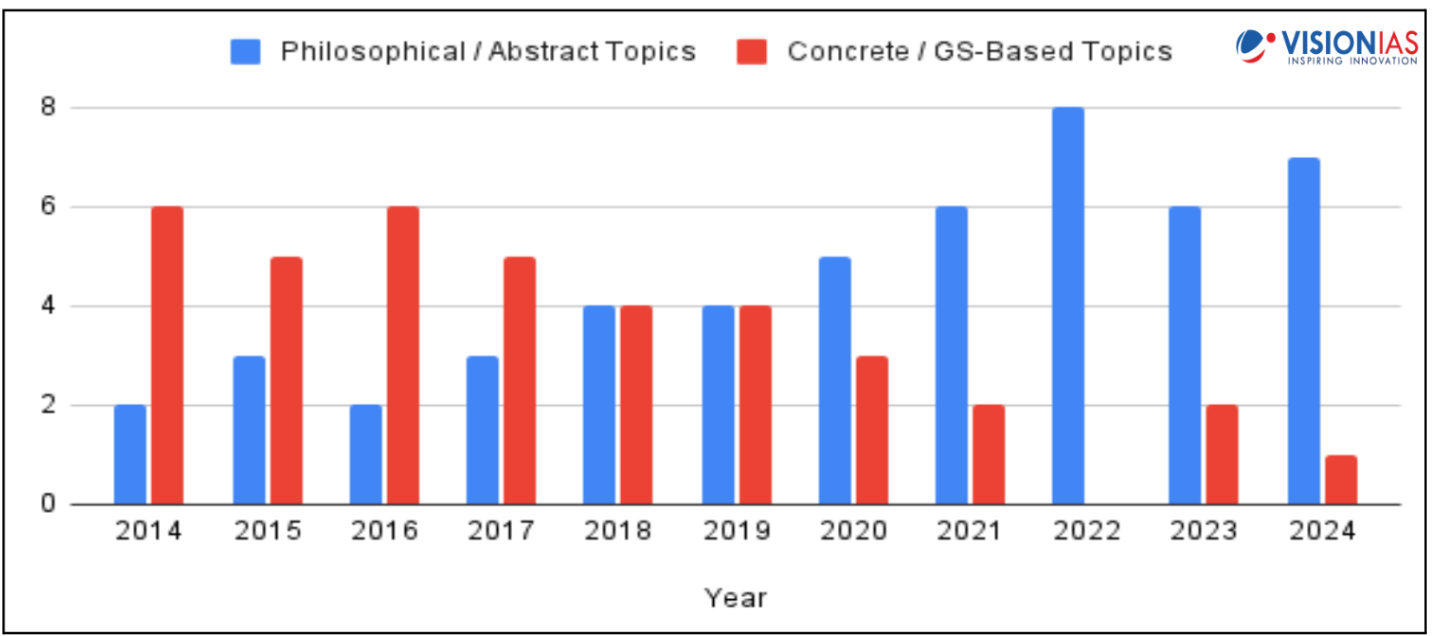
Between 2014 and 2017, most essay topics for UPSC were GS-aligned—governance, economic development, women, technology, and social justice. Familiar ground. If you had revised your GS notes well, you could write a decent essay. But that changed.
UPSC Essay PYQ depicts that starting in 2018, abstract and philosophical themes started showing up more frequently. By 2022, the shift was complete: all eight essay topics were abstract or philosophical in nature.
This was not a glitch. It was a deliberate calibration. UPSC was sending a message loud and clear: We’re not just looking for administrators. We’re looking for thinkers.
A New Kind of Preparation for 2025
If you are writing Mains 2025, this means one thing: your essay preparation can not rely on just GS knowledge or current affairs fodder. You need a new toolkit—one that combines intellectual depth, emotional maturity, and ethical clarity.
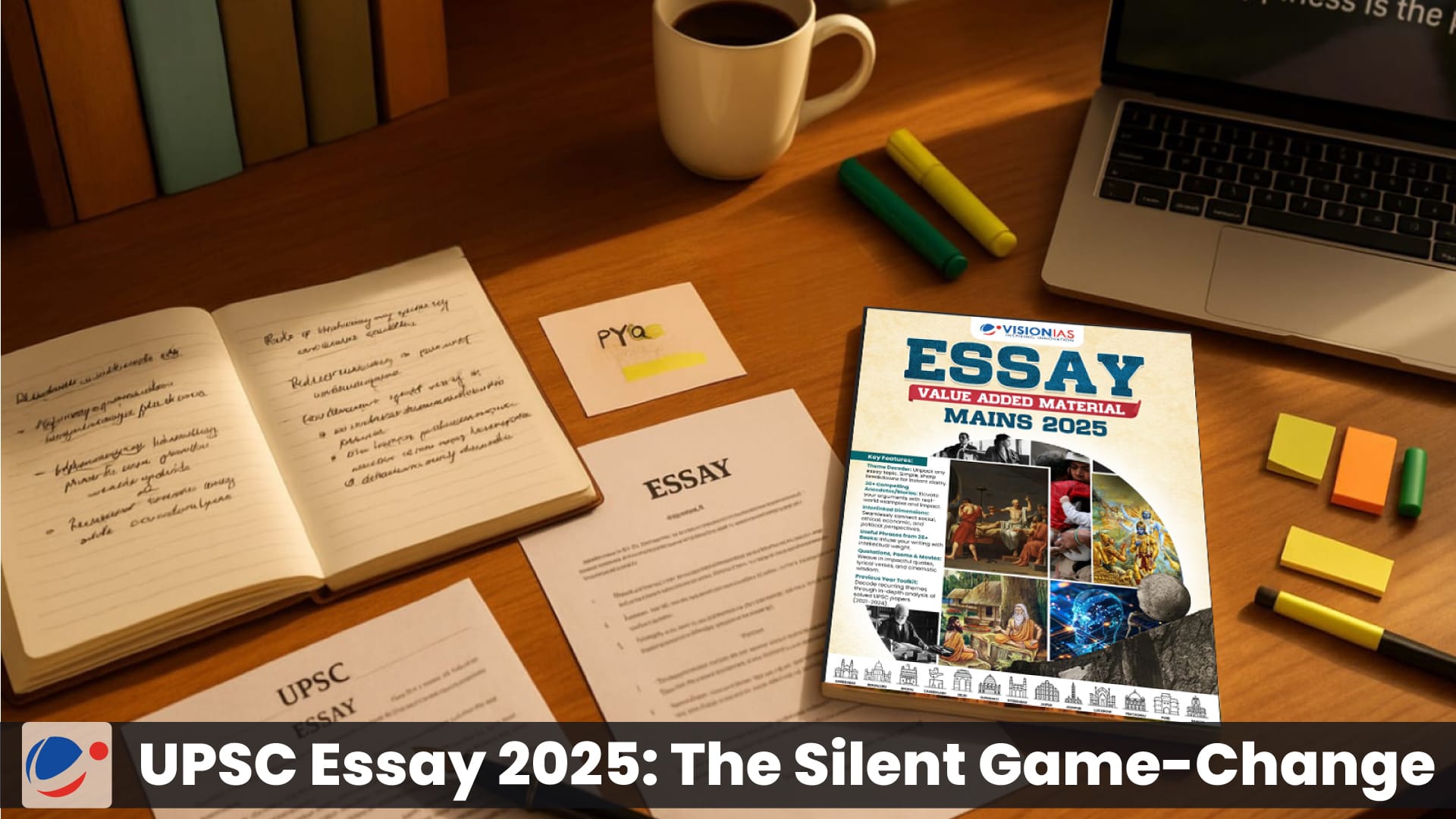
This is where the Essay Value Added Material for Mains 2025 by Vision IAS becomes more than just another document. It becomes a thinking framework.
What Makes This Document Different?
The Essay VAM does not just tell you what UPSC is doing, it prepares you to respond with confidence and originality.
It starts with an insightful trend analysis of the past decade’s topics from 2014-2024. But it doesn’t stop at data. The real value lies in strategic framework: how to break down abstract topics, how to apply multidimensional thinking, and how to blend real-world examples with philosophical nuance.
Your Personal Thinker’s Toolkit
The core of this document is Section 2—a ready-to-use bank of philosophical and thematic essays—on ideas like truth, freedom, identity, justice, simplicity, and power. Each concept is unpacked through:
- Famous thinkers & quotes (Tagore and Mandela)
- Anecdotes from public life, history, economy or international relations
- Movie, Poem & literary references (from 1984 to The Pursuit of Happyness)
- Case studies and counter-views to develop nuanced perspectives
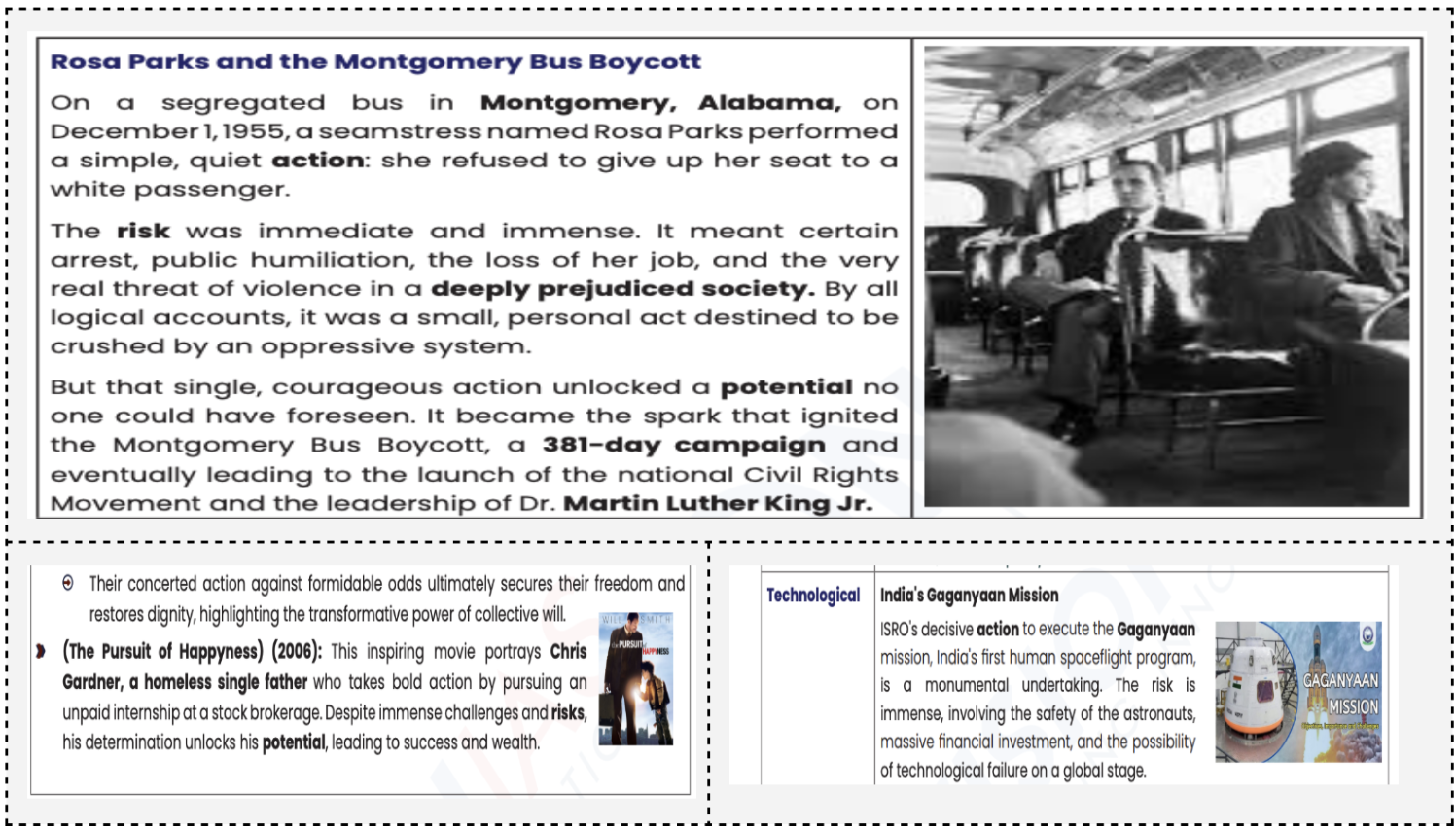
This section does not just prepare you for specific topics, it equips you to handle any philosophical prompt with depth and balance.
Think Like Socrates, Write Like a Civil Servant
One of the document’s most brilliant touches is the recurring box: Think like Socrates. This is not just branding. It’s a shift in mindset.
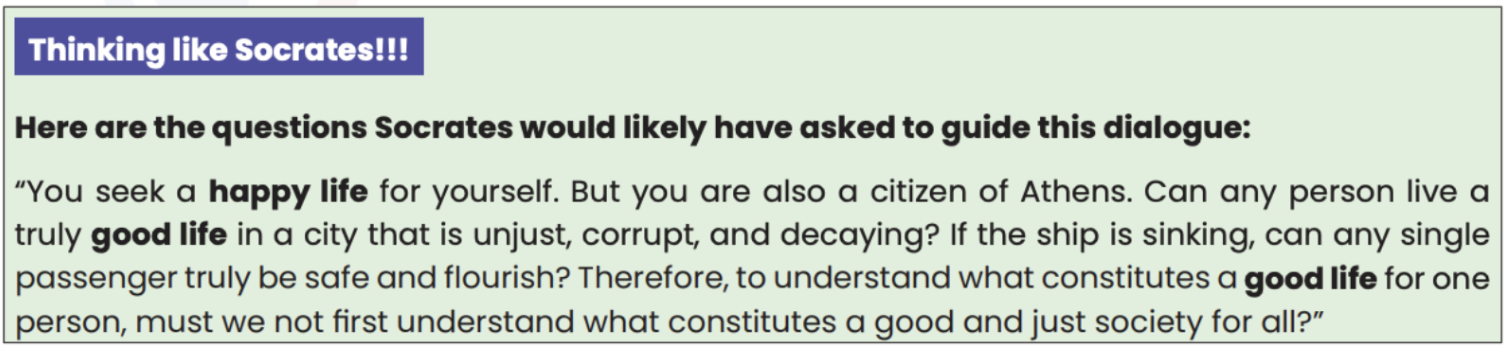
It trains you to challenge assumptions, break down abstractions, and connect ideas across time and space. And if there’s one trait UPSC seeks in future civil servants, it is clarity of ethical and philosophical thought.
Learning Through Deconstruction: PYQ Analysis
The final section, Section 3, breaks down Previous Year Questions (PYQs) into digestible, teachable insights.
Let’s say you are faced with the 2024 topic: “Forests precede civilizations, and deserts follow them.” At first glance, poetic. But how do you convert this into an essay? The Essay VAM shows you how to break it down:
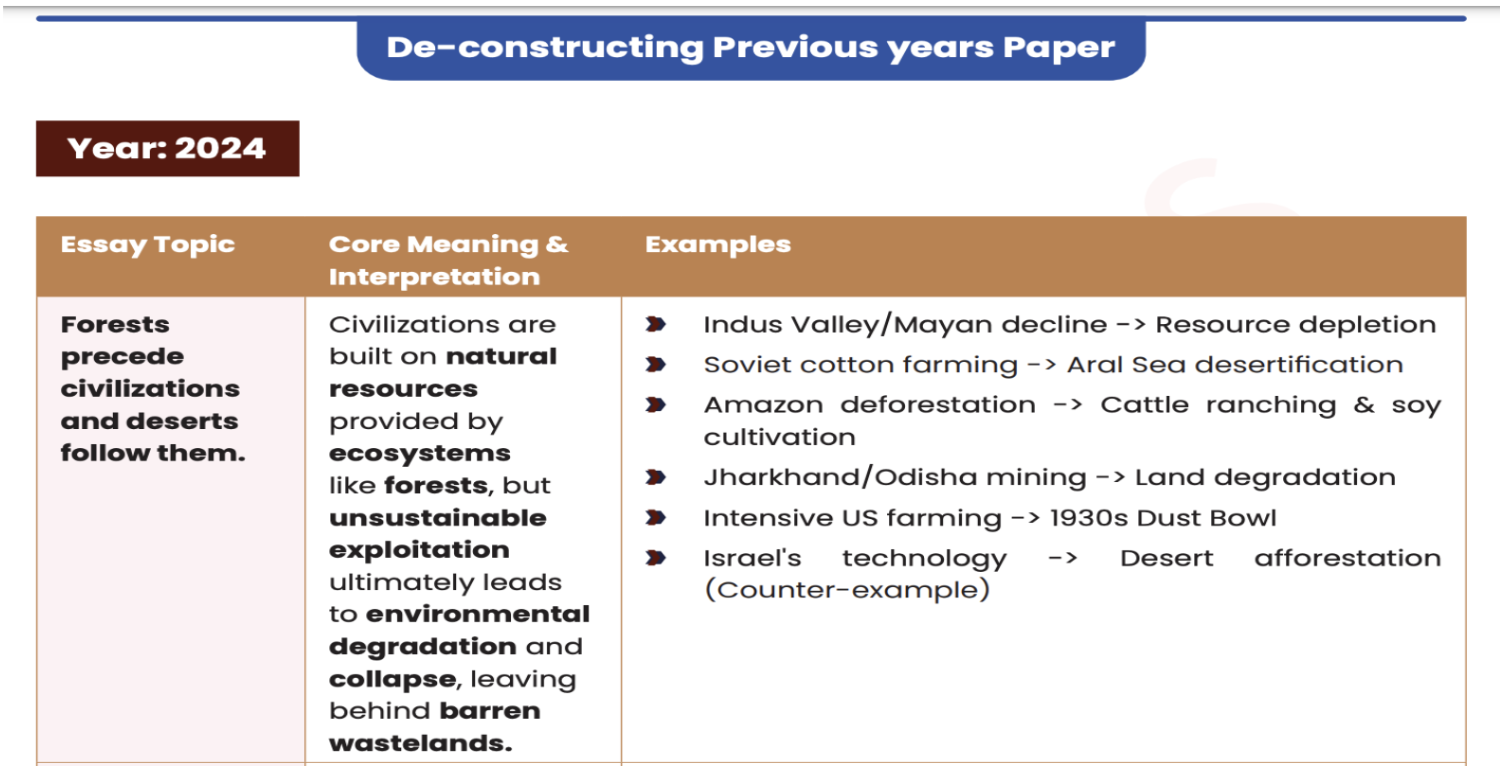
This is not model answer spoon-feeding. It’s thinking scaffolding. The result? You not only understand the topic—you learn how to own it.
Unlike generic essay books that offer fixed formats and repeated essays, the VisionIAS Essay Value Added Material is designed like a well-stocked pantry—rich with ingredients, flexible in style.
In the digital age of distractions and content fatigue, where YouTube reels promise “top 5 quotes to crack UPSC essay” and Telegram groups circulate recycled PDFs and “topper copy,” this Essay VAM material is grounded, original, and unapologetically high-quality.
The Final Word
Your Essay is not a GS answer. It’s a reflection of how you think. And when you’re sitting in that exam hall, staring at a blank sheet with “Freedom is a double-edged sword” printed on it, it’s this kind of preparation that will matter—not your notes, not your test scores, but your ability to write with depth, balance, and conviction.
The Essay Value Added Material for Mains 2025 does not just prepare you to write better. It prepares you to think better. And that’s what UPSC really wants.