Answer Writing
Decoding the Dynamic: Deep Thematic Overlap in UPSC Mains 2025 GS Paper-III from VisionIAS Test Series
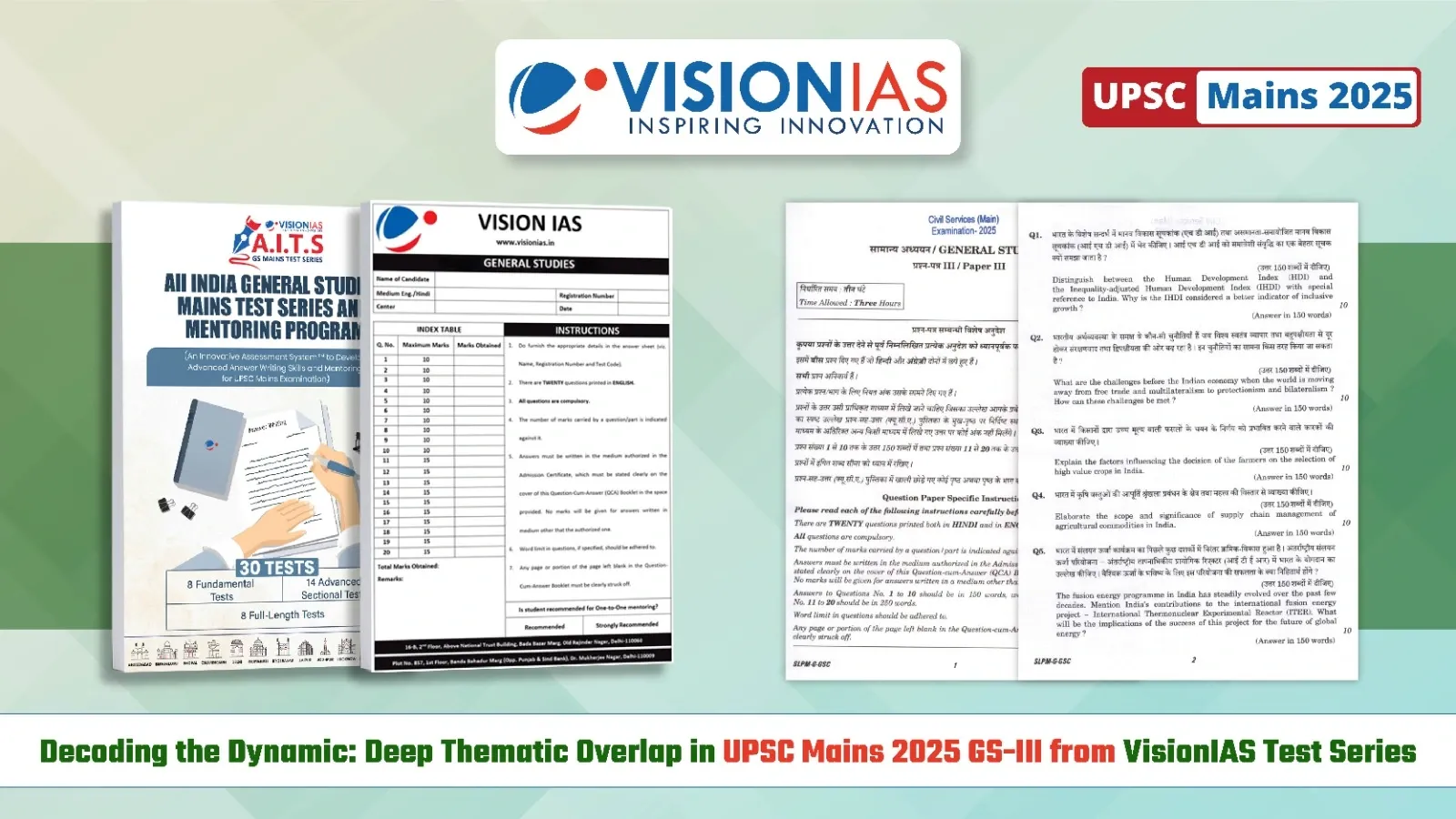















The UPSC Mains 2025 General Studies Paper-3 once again underscored its reputation as the most dynamic and application-oriented paper, testing candidates on the intricate nexus of the Indian Economy, Science & Technology, Environment, and Internal Security. The paper demanded not just rote knowledge but a deep, nuanced understanding of contemporary issues linked to foundational concepts.
In this landscape of evolving challenges, comprehensive preparation is key. We at VisionIAS are proud to highlight that 15 out of 20 questions in the UPSC Mains 2025 GS Paper 3 had a deep thematic overlap with our All India Mains Test Series. The alignment wasn’t just about single questions; it was about covering key themes from multiple angles, ensuring aspirants were prepared for any variation. This 75% reflection validates our research-driven approach to preparing aspirants for the Civil Services Mains 2025 GS3 paper.
At a Glance: What UPSC Mains GS-III 2025 Really Tested
Before diving into a question-by-question analysis, it’s crucial to understand the underlying philosophy of the GS3 paper this year. The paper was less a test of isolated facts and more a test of integrated thinking.
- Interdisciplinary Depth Over Silos: The boundaries between subjects blurred. Questions skillfully braided concepts from Economy ↔ Technology ↔ Environment ↔ Security into single prompts, demanding holistic answers.
- Policy Literacy and a Feel for Data: Aspirants were nudged to connect the dots between growth, inclusion, and sustainability. Answering well required a grasp of climate finance, job creation in MSMEs, and the realities of India’s food systems.
- Grounded, India-First Illustrations: Generic, global examples fell short. The paper rewarded candidates who could cite specific Indian schemes, committee recommendations, and guidance from bodies like the RBI, SEBI, and NDMA.
- An Outcome-Oriented Mindset: The paper constantly asked, “So what?” The implications, trade-offs, potential institutional fixes, and key metrics mattered just as much as defining the core concepts.
Question Reflection Mapping: UPSC 2025 vs. VisionIAS Test Series
The deep thematic alignment is best understood by looking at the reflections from the VisionIAS test series questions. The following table showcases how a single UPSC question was often addressed through multiple questions in our tests, preparing aspirants for the topic’s various dimensions.
Mastering GS-3 Answer Writing
Knowing the content is only half the battle; scoring high in GS3 depends critically on the art of answer writing. This paper demands a specific skill set that goes beyond generic answer structures.
A high-scoring GS-3 answer must be:
- Data-Driven: Arguments must be substantiated with relevant data from the Economic Survey, Budget, RBI reports, and other official sources.
- Multi-Dimensional: Answers need to connect the economic, technological, environmental, and security angles of an issue seamlessly.
- Solution-Oriented: A significant portion of marks is reserved for a practical, forward-looking “way forward” that includes specific, actionable suggestions.
VisionIAS provides a complete ecosystem to develop these skills:
- Practicing Interdisciplinary Thinking: The questions in our All India Mains Test Series are intentionally framed to be interdisciplinary, forcing aspirants to think beyond subject silos. The model answers provide a blueprint on how to structure these integrated points logically.
- Refining Structure through Evaluation and Feedback: This is where true value is created. Our detailed, multi-stage evaluation process provides pointed feedback on structure, relevance of data, quality of introduction and conclusion, and the practicality of suggestions. This feedback loop is the fastest way to turn knowledge into marks. Our Answer Writing Workshops further focus on honing these presentation skills under expert guidance.
Preparation Strategy for UPSC GS Paper 3
- Link Current Affairs with Static Syllabus: This is the golden rule for GS3. The reflection shows how questions are built around current triggers like NITI Aayog reports, government policies, or rising global protectionism. Your preparation must mirror this approach.
- Focus on Government Schemes & Missions: Questions on PLI and the Semiconductor Mission highlight that UPSC expects you to know the why, how, and what next of major policies, not just their objectives.
- Embrace Technology & its Applications: Whether it’s CCUS for climate change or biotechnology for energy, technology as a solution is a recurring theme in the UPSC 2025 paper.
- Mastering Answer Writing: The dynamic nature of UPSC GS Paper 3 demands more than just knowledge; it requires structured, analytical answers. Consistent practice is key, making dedicated answer writing for the UPSC mains a non-negotiable part of the strategy.
Resource Optimization with VisionIAS
To transform your preparation into a high score, optimizing your resources and consistently enhancing your skills is crucial.
- Integrated Test Series Practice: Test series should complement, not replace, comprehensive reading. They are crucial for application, time management, and identifying weak areas. Our All India General Studies Mains Test Series is designed to integrate seamlessly with your core preparation, ensuring you are tested on the most relevant themes.
- Dynamic Current Affairs Coverage: To tackle the current-affairs-heavy nature of GS3, static knowledge must be constantly updated with relevant context. VisionIAS’s Monthly Current Affairs Magazine provides the necessary depth to link breaking news with the core syllabus.
The UPSC Mains 2025 GS Paper-3 was a challenge, but a predictable one for those who followed a disciplined and strategic approach. The significant 75% reflection from the VisionIAS Test Series is not a matter of chance, but a result of a dedicated methodology that prioritizes relevance, depth, and exam-centricity.