Current Affairs
Government Revises Startup Recognition Framework to Strengthen Startup India Action Plan
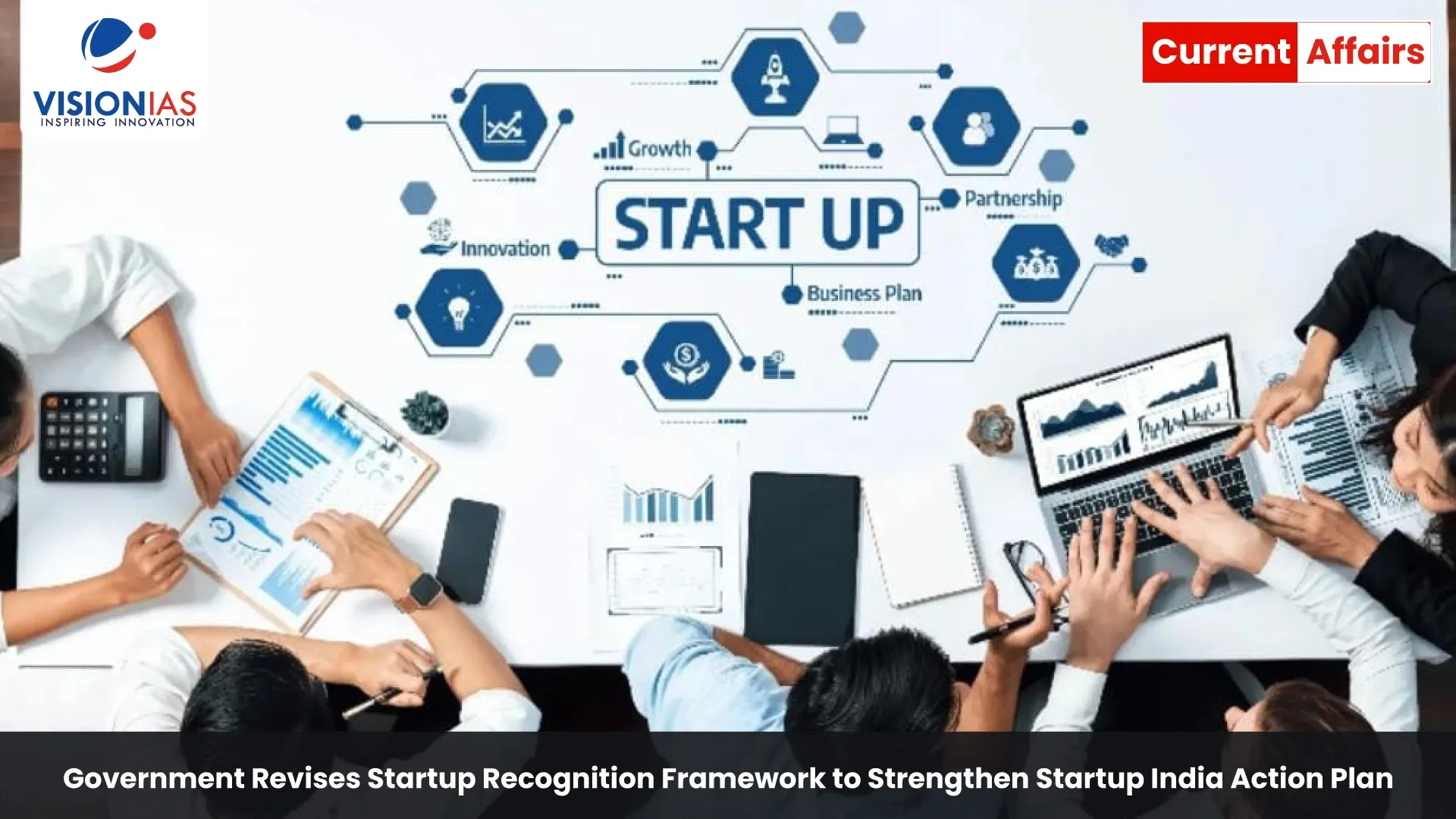





















The Government has revised the startup recognition framework to strengthen Startup India and position India as a global innovation and manufacturing hub.
The Government of India has revised the startup recognition framework, marking an upgrade for the Startup India ecosystem as it enters its second decade. Announced in February 2026, these updates reflect the government’s commitment to positioning India as a global innovation powerhouse and addressing the needs of entrepreneurship across technology sectors.
The revised startup recognition framework introduces changes including enhanced turnover thresholds, a category for deep tech startup ventures, and the inclusion of cooperative societies, signaling a move towards a more inclusive, research driven economic growth.
Expanded Turnover Threshold: Supporting Growth Ventures
One of the changes under the revised framework is the increase in the annual turnover limit for general startup recognition. The threshold has been doubled from ₹100 crore to ₹200 crore, acknowledging that innovation driven enterprises often achieve revenue scale while continuing to reinvest in research and development.
This revision addresses a bottleneck faced by startups that were crossing the turnover cap and losing access to regulatory benefits, tax exemptions, and government procurement. The enhanced limit ensures that Department for Promotion of Industry and Internal Trade (DPIIT) startup recognition remains relevant throughout a company’s growth trajectory, from prototype development to commercialization and public listing.
By maintaining eligibility for a longer period, startups can continue to benefit from Section 80-IAC tax holidays, angel tax exemptions, and simplified compliance norms. This creates an environment for reinvestment into innovation, contributing to sustained economic growth and job creation.
Deep Tech Startup Category: Fostering Breakthrough Innovation
The introduction of a deep tech startup category indicates how India supports frontier technology ventures. The government has extended the age limit for these entities from 10 years to 20 years from the date of incorporation or registration. This recognizes that innovations in frontier technologies such as semiconductors, quantum computing, space technology, and advanced materials require longer development timelines and higher capital intensity.
The turnover ceiling for deep tech startup recognition has been raised to ₹300 crore, reflecting the economics of research intensive businesses that often require revenue reinvestment before achieving profitability. This category acknowledges that innovation in scientific and engineering disciplines follows a non-linear path, with extended gestation periods between research and market ready solutions.
To qualify as a deep tech startup, entities must demonstrate work on solutions based on new knowledge or advancements within scientific or engineering disciplines that are yet to be developed. The framework emphasizes Technology Readiness Levels (TRL) as a merit based assessment criterion, shifting the focus from age-based eligibility to technological maturity. This ensures that innovative ventures receive the patient capital environment and fiscal support to achieve breakthrough discoveries.
Inclusion of Cooperatives: Decentralizing Innovation
In a move to democratize entrepreneurship and extend the benefits of Startup India to grassroots innovators, the revised framework now includes cooperative societies as eligible entities. Multi-State Cooperative Societies registered under the Multi-State Cooperative Societies Act, 2002, as well as Cooperative Societies registered under State and Union Territory Cooperative Acts, can now apply for startup recognition.
This inclusion is significant for driving technological adoption in agriculture, rural manufacturing, and community based enterprises. By integrating cooperatives into the DPIIT-recognised startup ecosystem, the government aims to catalyze innovation in sectors that impact millions of Indians, fostering inclusive economic growth and livelihood generation.
Women-led Self-Help Groups and agricultural cooperatives can now access formal credit, government procurement opportunities through the Government e-Marketplace (GeM), and mentorship programs. This creates pathways for technology-led skill development in Tier-II and Tier-III cities, strengthening the innovation pipeline at the community level.
Startup Recognition: Fiscal Benefits and Market Access
The revised startup India framework synchronizes multiple fiscal incentives to create a support lifecycle. Section 80-IAC provides a 100% tax deduction on profits for three consecutive financial years within the first 10 years (or 20 years for deep tech startup entities), enabling reinvestment into scaling and innovation.
The exemption from angel tax protects recognized startups from taxation on capital raised above fair market value, provided funds are deployed productively rather than diverted into non-core assets. The Union Budget 2026-27 introduced customs duty exemptions on critical minerals, healthcare innovation inputs, and electronics components, empowering DSIR recognized ventures.
Beyond fiscal benefits, Department for Promotion of Industry and Internal Trade (DPIIT) startup recognition provides access to government procurement through the Government e-Marketplace (GeM). Startups enjoy exemptions from prior experience and turnover requirements in tenders, waivers on Earnest Money Deposit, and access to trial orders, creating cash flow opportunities while building core intellectual property.
Other Initiatives Strengthening Startup Ecosystem in India
Startup India, launched in 2016, is the flagship programme for building a strong and inclusive startup ecosystem by simplifying regulations, easing access to funding, and strengthening industry–academia collaboration. Measures such as self-certification under labour and environmental laws, faster patent examination, tax incentives, and the Fund of Funds for Startups have lowered entry barriers, while the Startup India Seed Fund Scheme, Startup India Hub, and national startup rankings have expanded mentorship, incubation, and early-stage support.
Complementary initiatives have broadened the innovation landscape. The Atal Innovation Mission nurtures entrepreneurship through Atal Tinkering Labs, Incubation Centres, and Community Innovation Centres, while Digital India, Make in India, and Production Linked Incentive schemes promote technology adoption and manufacturing growth.
In January 2026, the Department of Scientific and Industrial Research removed the three-year eligibility rule for recognition under the Industrial Research and Development Promotion Programme, allowing early-stage startups with strong Technology Readiness Levels and dedicated R&D infrastructure to access fiscal incentives. The Union Budget 2026–27 further strengthened this ecosystem through customs duty exemptions on critical inputs and integration with the National Testing Grid, the ₹1 lakh crore Research Development and Innovation Fund (RDIF), and industry–academia platforms, supporting innovation across sectors and regions.
Conclusion
As the Startup India Initiative enters its second decade, the revised framework positions India as a global hub for research driven innovation, fostering economic growth through breakthrough technologies and inclusive development.
This support system spanning recognition, fiscal incentives, infrastructure access, and market opportunities ensures that India’s innovation economy is future ready and competitive.
Master Digital Age Governance & Technology Trends with VisionIAS Comprehensive Current Affairs →

Revised Startup Recognition Framework FAQs
1. What is the new turnover limit for startup recognition in India 2026?
Ans. ₹200 crore annually.
2. What is the age limit for deep tech startups under the new framework?
Ans. 20 years from the date of incorporation or registration.
3. What is the turnover threshold for deep tech startup recognition?
Ans. ₹300 crore.
4. What technologies qualify for the deep tech startup category?
Ans. Semiconductors, quantum computing, space technology, and advanced materials etc.
5. Which platform provides government procurement access to recognized startups?
Ans. Government e-Marketplace (GeM).