Current Affairs
Parakram Diwas: Honoring Netaji Subhas Chandra Bose’s Legacy of Courage and Sacrifice
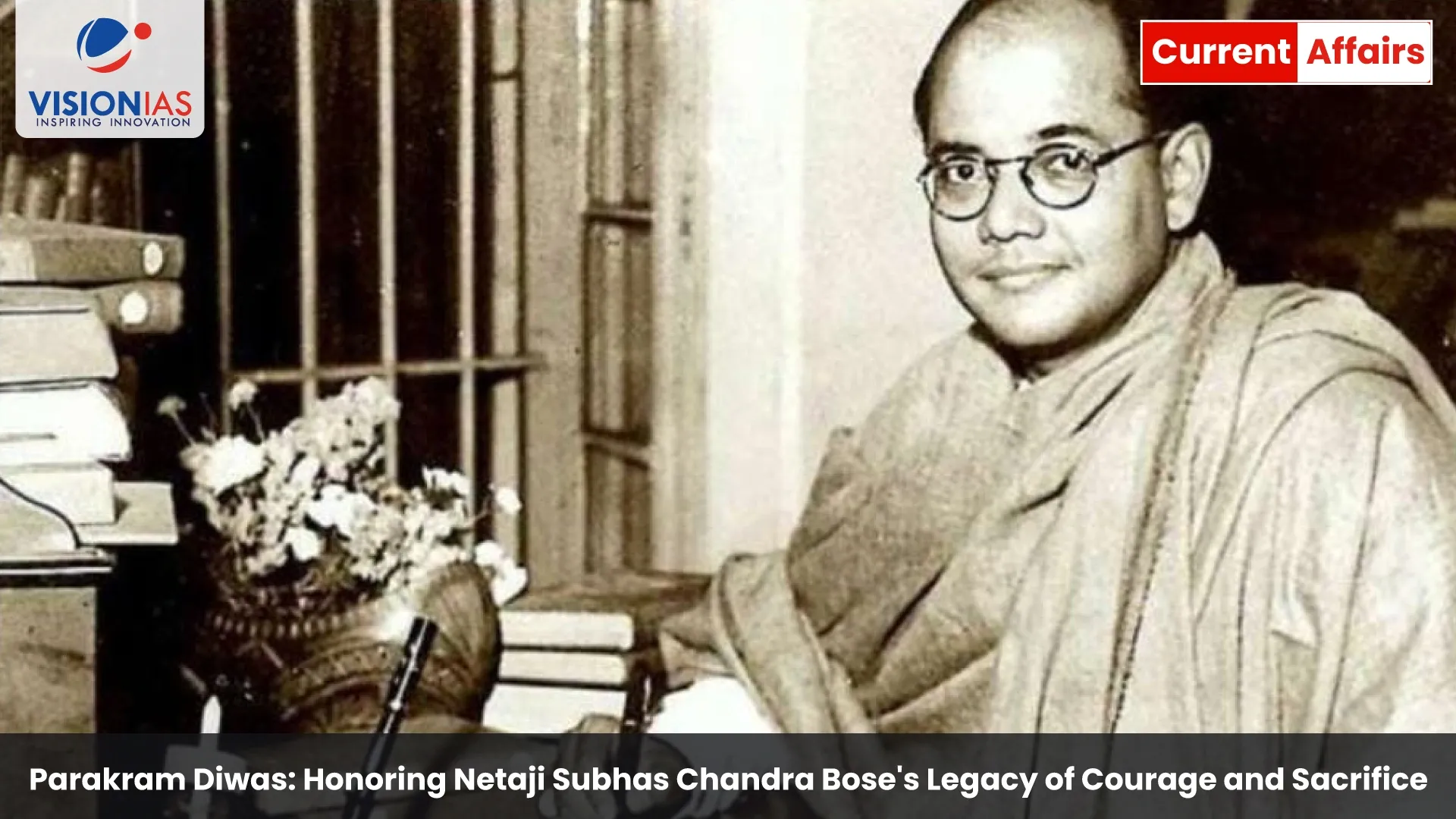
























On Parakram Diwas, the nation honors Netaji Subhas Chandra Bose, remembering his courage and unparalleled contribution to India’s freedom struggle.
Parakram Diwas, observed annually on January 23, commemorates the birth anniversary of one of India’s most fearless freedom fighters, Netaji Subhas Chandra Bose. The day, instituted in 2021, celebrates his courage, patriotism, and approach to India’s Independence struggle. As India marked the 129th birth anniversary of Netaji in 2026, the celebrations showcased a blend of historical reverence, technological innovation, and governance priorities.
Netaji Subhas Chandra Bose represents a chapter in India’s freedom movement as a leader who rejected conventional methods and pursued armed resistance through the Indian National Army (INA). His call, “Give me blood, and I shall give you freedom,” continues to inspire generations of Indians, particularly the youth, to embrace leadership and service to the nation.
Foundational Sacrifice and Early Political Career
Born into an affluent Bengali family, Netaji Subhas Chandra Bose ranked fourth in the prestigious Indian Civil Service examination in 1920. However, in April 1921, he resigned from this position, declaring that service to the British Empire was incompatible with service to the nation. This act of career sacrifice became the foundational moment of his political life, demonstrating his unwavering commitment to India’s freedom.
Netaji Subhas Chandra Bose’s political activism intensified through the 1920s and 1930s. He founded the newspaper ‘Swaraj’ in 1922 to propagate nationalist ideas and mobilize public opinion against colonial rule.
His organizational abilities and mass appeal led to his election as President of the Indian National Congress (INC) in 1938, and again in 1939. However, ideological differences with Mahatma Gandhiji over the methods of struggle led to his resignation from the INC presidency in 1939.
Undeterred, he founded the All India Forward Bloc in May 1939, seeking to consolidate radical elements within the independence movement and advocate for complete independence through more assertive means.
Indian National Army or Azad Hind Fauj
After a dramatic escape from house arrest in 1941, Netaji Subhas Chandra Bose traveled through multiple countries, reaching Southeast Asia. In Singapore in 1943, he took command of the Azad Hind Fauj, transforming it from a demoralized prisoner of war contingent into a disciplined fighting force.
Netaji Subhas Chandra Bose’s call for “Total Mobilization” inspired thousands of Indians in Southeast Asia to join the struggle. His formation of the Rani of Jhansi Regiment broke social taboos by recruiting and training women for frontline combat roles, transforming both military and social conventions of the era. This was the first all-female combat regiment in Asian history.
Imphal Campaign
The INA, fighting alongside Japanese forces, crossed into India in March 1944, planting the tricolour at Moirang. He established the Provisional Government of Free India in Imphal to mobilize Indians for an anti-British revolt.
Though the Imphal and Kohima campaigns ended in retreat due to monsoon conditions and supply disruptions, the willingness of INA soldiers to sacrifice everything for freedom left an indelible impact on India’s collective consciousness. The trials of INA officers at the Red Fort in 1945 became a watershed moment, with public opinion rallying behind these soldiers and accelerating the end of British rule.
Enduring Mystery and Modern Symbolism
The narrative of Netaji Subhas Chandra Bose extends beyond documented history into domains of mystery. Official accounts state he died in a plane crash on August 18, 1945, with his ashes preserved at Renkoji Temple in Tokyo. However, conflicting commission findings have fueled decades of debate, with his daughter Anita Bose Pfaff continuing to appeal for repatriation of the remains.
Since 2014, efforts have reshaped India’s public spaces to reflect nationalism. The installation of Netaji’s 28-foot black granite statue under the Grand Canopy at India Gate, replacing the earlier colonial symbolism, manifests this narrative shift. Standing on Kartavya Path, the statue connects the concept of duty with national defense.
Honoring Excellence: Netaji Subhash Chandra Bose Aapda Prabandhan Puraskar
Individual Laureate: Lt. Col. Seeta Ashok Shelke
Lt. Col. Seeta Ashok Shelke of the Indian Army received the individual award for her leadership during the 2024 Wayanad Landslide rescue operations. As the sole female officer in her unit, Lt. Col. Shelke’s leadership resonated with the legacy of Netaji Subhas Chandra Bose’s historic Rani of Jhansi Regiment, the first all female combat regiment in Asian history.
Institutional Laureate: Sikkim State Disaster Management Authority
The Sikkim State Disaster Management Authority earned recognition for proactive management of Glacial Lake Outburst Floods and establishing community based early warning systems in high altitude zones. Their work in implementing Panchayat Level Preparedness Plans demonstrates the shift from reactive relief to proactive risk reduction, making Sikkim a model state in disaster management.
Sri Vijaya Puram: Heart of 2026 Celebrations
The primary festivities unfolded at Sri Vijaya Puram, formerly Port Blair, in the Andaman and Nicobar Islands. This location holds historical significance as the site where Netaji Subhas Chandra Bose hoisted the tricolour on December 30, 1943, declaring these islands the first liberated territory of the Provisional Government of Free India.
The main function at Netaji Stadium, presided over by Admiral D.K. Joshi, the Lieutenant Governor, emphasized the islands’ transformation from a site of colonial oppression to a symbol of sovereign assertion. This choice reinforces India’s maritime heritage and geopolitical importance in the Indo-Pacific region.
Red Fort: Technology Meets Tradition
The historic Red Fort in New Delhi hosted a nine day cultural extravaganza called Bharat Parv. The venue choice was deliberate, as the Red Fort witnessed the INA trials of 1945, where British colonial justice confronted the spirit of Netaji Subhas Chandra Bose’s army.
Digital Engagement for the Amrit Generation
Recognizing that youth consume history through digital platforms, the government leveraged the MyGov platform to create engagement around Parakram Diwas. The 2026 campaign included essay writing competitions focused on Netaji Subhas Chandra Bose’s slogan, singing competitions for diverse renditions of Vande Mataram, and quizzes linking his vision of self sufficiency with current Atmanirbhar Bharat policies.
Conclusion
As the 129th birth anniversary concluded, Netaji Subhas Chandra Bose’s words echoed across the nation: “Freedom is not given, it is taken.” Parakram Diwas ensures that this spirit of determination remains alive, inspiring each generation to serve the nation with courage and patriotism.
Netaji Subhas Chandra Bose has been elevated to the apex of India’s national pantheon, serving as the historical anchor for a nation that values courage, strategic autonomy, and resilience.

Master Digital Age Governance & Technology Trends with VisionIAS Comprehensive Current Affairs →
Parakram Diwas FAQs
1. What is Parakram Diwas and when is it celebrated?
Ans. Parakram Diwas is observed annually on January 23 to commemorate Netaji Subhas Chandra Bose’s birth anniversary.
2. When was Parakram Diwas first instituted in India?
Ans. 2021
3. Which birth anniversary of Netaji Subhas Chandra Bose was celebrated in 2026?
Ans. 129th birth anniversary
4. What was the name of the first all-female combat regiment formed by Netaji?
Ans. Rani of Jhansi Regiment
5. When did Netaji Subhas Chandra Bose hoist the tricolour in Andaman and Nicobar Islands?
Ans. December 30, 1943