Mains Economy
Economic Survey 2025–26: Growth Signals, Global Risks and Policy Choices Before the Union Budget
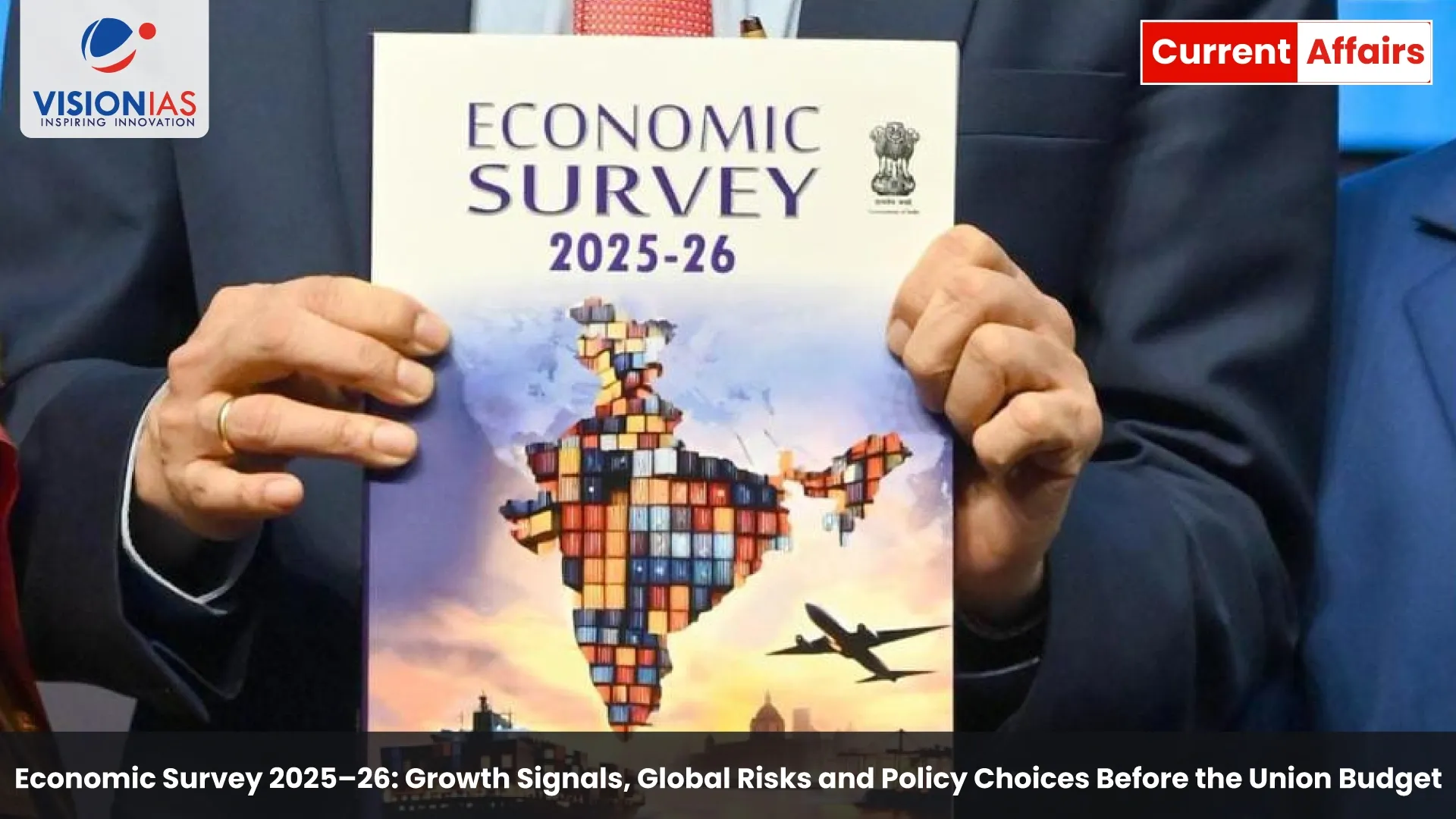
























Union Minister for Finance and Corporate Affairs Smt. Nirmala Sitharaman tabled the Economic Survey 2025-26 in the Parliament on 29, January, 2026.
The Economic Survey 2025–26, tabled in Parliament by Union Finance Minister Nirmala Sitharaman, provides an official assessment of the state of the Indian economy ahead of the Union Budget 2026. Prepared by the Economic Division of the Department of Economic Affairs, Ministry of Finance under the guidance of Chief Economic Adviser V.A. Anantha Nageswaran, the Survey evaluates domestic economic performance, global risks, and policy priorities.
It highlights India’s sustained growth momentum, revised medium-term growth potential, and the importance of inclusive development, while cautioning against heightened global uncertainty. As the principal pre-Budget document, the Economic Survey serves as a framework for fiscal, monetary, and structural policy decisions in the year ahead.
India’s Growth Trajectory and GDP Outlook
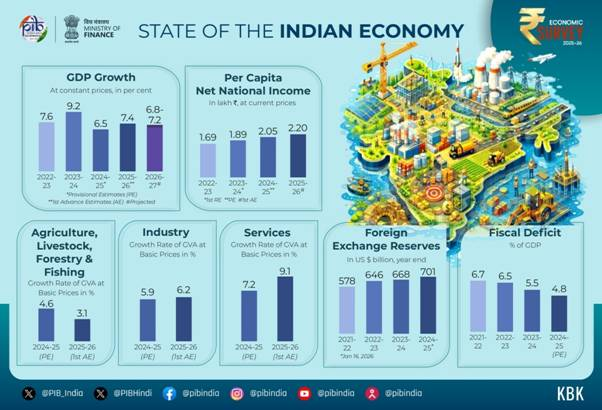
The Economic Survey revises India’s potential growth rate to around 7%, up from the earlier estimate of 6.5%. It projects GDP growth in the range of 6.8% to 7.2% for FY27, reaffirming India’s position among the fastest-growing major economies. According to the Survey, growth in FY26 has been supported by stable private consumption, improved agricultural output, and continued public investment. The Ministry of Finance notes that domestic demand has remained resilient despite global headwinds, reflecting macroeconomic stability and steady employment conditions.
The Survey also highlights that India’s growth performance has been relatively broad-based, with agriculture and services remaining major contributors to Gross Value Added. Manufacturing growth, while uneven, is expected to strengthen as infrastructure investment and supply-side reforms gain traction. The Survey underlines that sustaining high growth will require consistent policy execution rather than short-term stimulus measures.
Global Economic Environment and External Risks
While the domestic outlook remains stable, the Economic Survey presents a cautious assessment of the global economy. It estimates a 10–20% probability of a global economic crisis worse than the 2008 financial crisis in 2026. Even in its best-case scenario, the Survey expects global conditions to remain fragile, marked by trade disruptions, geopolitical tensions, and financial volatility. According to the Survey, the global economic order is increasingly fragmented, with reduced predictability in trade, capital flows, and technology access.
The Survey emphasises that India is relatively better placed than many economies due to its large domestic market, lower dependence on external demand, and strong foreign exchange reserves. However, it cautions that these buffers do not guarantee insulation from global shocks. As part of its external sector strategy, the Survey calls for diversification of trade partners, strengthening of supply chains, and enhanced policy coordination to manage external vulnerabilities.
Fiscal Position and Macroeconomic Stability
The Economic Survey notes that the Centre remains on track to meet its fiscal deficit target of 4.4% of GDP for FY26. It highlights the role of credible fiscal consolidation in maintaining investor confidence and containing borrowing costs. The Survey also points out that government capital expenditure has increased substantially over recent years, reinforcing infrastructure-led growth without compromising fiscal discipline.
On inflation, the Survey states that price pressures have moderated significantly. Average headline inflation during FY26 has remained low, supported by easing food and fuel prices. The Survey credits coordinated fiscal and monetary actions for anchoring inflation expectations and supporting household purchasing power. It adds that maintaining price stability will remain a key policy priority in an environment of global volatility.
Consumption, Investment and Demand Conditions
Private Final Consumption Expenditure has shown steady growth, accounting for a significant share of GDP. The Survey attributes this to stable employment conditions, moderate inflation, and improved rural demand following a favourable monsoon. Urban consumption has also benefited from tax rationalisation and higher disposable incomes.
Investment activity continues to be driven largely by public capital expenditure. According to the Ministry of Finance, government-led infrastructure spending has created capacity in transport, energy, and logistics, helping reduce supply-side constraints. The Survey notes that sustained public investment is expected to crowd in private investment over time, provided regulatory certainty and policy predictability are maintained.
Inclusive Growth and Focus on MSMEs
A central theme of the Economic Survey 2025–26 is inclusive development, with emphasis on farmers, MSMEs, and youth employment. The Survey identifies MSMEs as a critical pillar of employment generation, innovation, and exports.
It highlights the need to improve MSME access to credit, reduce compliance burdens, and strengthen integration with formal supply chains. The Survey also underscores the role of digital platforms, credit guarantee schemes, and targeted policy support in improving MSME productivity. Agriculture, Rural Economy and Food Management
Agriculture continues to play a stabilising role in the Indian economy. The Economic Survey notes that food grain production has increased due to higher output of rice, wheat, and coarse cereals. Strong agricultural performance has supported rural incomes and consumption demand. The Survey also highlights the need to improve agricultural productivity through better irrigation, market access, and technology adoption.
While acknowledging progress in rural development, the Survey calls for continued reforms in agricultural marketing, diversification of crops, and strengthening of food management systems. These measures, it argues, are necessary to ensure income stability for farmers and reduce vulnerability to climate and price shocks.
Manufacturing, Infrastructure and Capital Expenditure
The Survey reiterates that agriculture, manufacturing, and services must grow together to sustain long-term GDP growth. It highlights the sharp increase in government capital expenditure over the past decade, with investments spanning roads, railways, aviation, ports, and energy infrastructure. Improved connectivity and logistics are expected to lower costs and enhance competitiveness.
Manufacturing growth is identified as essential for job creation and export expansion. The Survey notes that policy initiatives aimed at improving ease of doing business, reducing regulatory friction, and supporting domestic production are beginning to yield results. However, it stresses that sustained manufacturing growth will depend on land, labour, and skill reforms at both the Centre and State levels.
Strategic Resilience and the Role of ‘Swadeshi’
Chief Economic Adviser V.A. Anantha Nageswaran described ‘Swadeshi’ as a legitimate policy instrument in a global environment where trade is no longer fully reciprocal. The Economic Survey outlines India’s shift from traditional import substitution towards strategic resilience and strategic indispensability. This approach focuses on building domestic capabilities in critical sectors while remaining integrated with global value chains.
The Survey argues that strategic resilience requires coordinated action by the State, private sector, and citizens. It also highlights the importance of anticipating supply disruptions, strengthening institutional capacity, and ensuring policy consistency. According to the Ministry of Finance, this strategy aims to balance openness with preparedness in an uncertain global order.
Setting the Context for the Union Budget 2026
As a prelude to the Union Budget, the Economic Survey provides guidance on policy priorities for the coming year. It calls for continued fiscal discipline, sustained capital expenditure, targeted support for MSMEs, and reforms in labour, land, and technology governance. The Survey emphasises that policy credibility and predictability will be critical assets in navigating global uncertainty.
The Ministry of Finance positions the Survey as a roadmap rather than a policy announcement, outlining trade-offs and constraints facing policymakers. Its assessment of growth, risks, and reforms sets the stage for Budget decisions aimed at strengthening resilience while sustaining momentum.
Conclusion
The Economic Survey 2025–26 presents a balanced assessment of India’s economic position. It highlights strong growth fundamentals and a revised medium-term growth outlook, while cautioning against global instability.
By focusing on inclusive development, MSME support, infrastructure investment, and strategic resilience, the Survey outlines a pathway for sustaining GDP growth in a complex global environment. As India approaches the Union Budget, the Survey reinforces the need for steady reforms, fiscal prudence, and coordinated policy action to support long-term economic stability.
Master Digital Age Governance & Technology Trends with VisionIAS Comprehensive Current Affairs →
Know more and register, VisionIAS Economy Sprint – Economic Survey & Union Budget for UPSC 2026
FAQs on Economic Survey 2025-26
1. What is India’s revised potential growth rate in Economic Survey 2025-26?
Ans. Around 7%.
2. What is India’s projected GDP growth for FY27?
Ans. 6.8% to 7.2%.
3. Who is India’s Chief Economic Adviser for Economic Survey 2025-26?
Ans. V.A. Anantha Nageswaran.
4. What sectors does the Survey identify as critical for inclusive growth?
Ans. Farmers, MSMEs, and youth employment.
5. What strategy does the Survey propose for global uncertainty?
Ans. Strategic resilience and strategic indispensability.