Mains Economy
Union Budget 2026–27: Blueprint for Viksit Bharat 2047
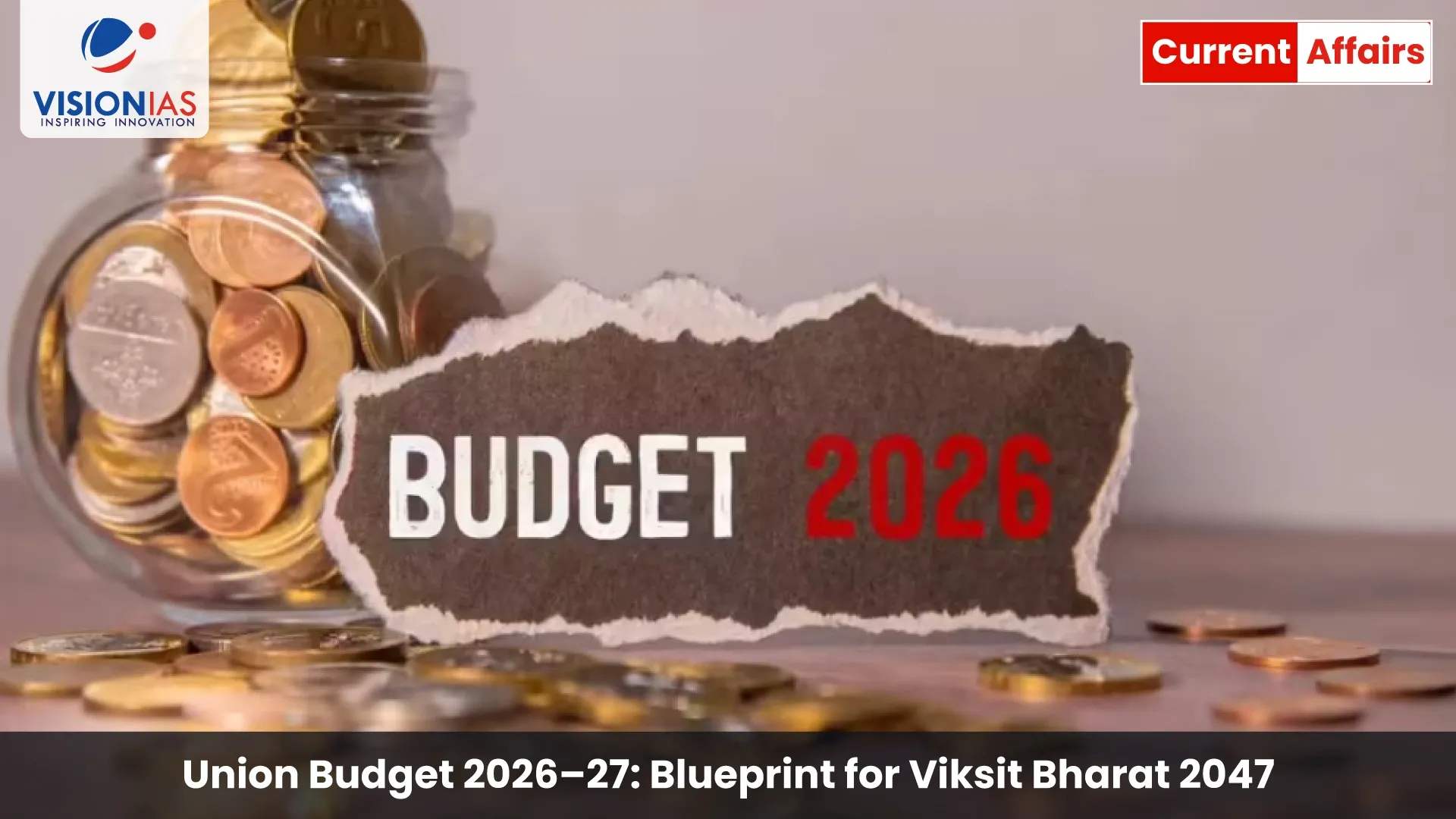


















Union Minister Nirmala Sitharaman tabled the Union Budget 2026-27 focusing on accelerating growth, building citizen capacity, and ensuring inclusive resource access for all.
The Union Budget 2026–27, presented by Finance Minister Nirmala Sitharaman on February 1, 2026, represents a key fiscal intervention following the assessment laid out in the Economic Survey. Prepared for the first time in Kartavya Bhawan, the budget outlines the government’s economic priorities amid global uncertainty and domestic growth imperatives.
With total expenditure estimated at ₹53.5 lakh crore and a fiscal deficit estimated at 4.3% of GDP, the budget seeks to sustain GDP growth while adhering to fiscal discipline. It reflects the Indian government’s effort to balance public investment, social spending, and macroeconomic stability.
The budget is anchored around three kartavyas: accelerating economic growth, building human capacity, and ensuring inclusive development. These pillars align with the broader objective of transforming India into a developed economy by 2047.
First Kartavya: Accelerating and Sustaining Economic Growth
The first kartavya focuses on maintaining growth momentum by strengthening productivity, manufacturing capacity, and infrastructure. This approach echoes the Economic Survey’s emphasis on capital formation and competitiveness as central to sustaining long-term growth.
A key initiative is Biopharma SHAKTI, with an allocation of ₹10,000 crore over five years. The programme aims to expand India’s pharmaceutical and biopharma capabilities by improving research infrastructure, expanding clinical trial capacity, and strengthening institutional support. The proposal includes setting up three new National Institutes of Pharmaceutical Education and Research and upgrading seven existing institutes to address skill and research gaps.
The semiconductor ecosystem receives renewed policy support through the India Semiconductor Mission 2.0. In parallel, the Electronics Components Manufacturing Scheme has been expanded to ₹40,000 crore to encourage domestic value addition. The budget also proposes Rare Earth Corridors in Odisha, Kerala, Andhra Pradesh, and Tamil Nadu to strengthen access to critical minerals required for electronics, renewable energy, and advanced manufacturing.
The textile sector is addressed through an integrated programme combining the National Fibre Scheme, the Textile Expansion and Employment Scheme, and targeted support for khadi, handloom, and handicrafts. The objective is to improve scale, productivity, and employment outcomes in a sector that continues to support a large workforce.
Infrastructure Development at Scale
Public capital expenditure (capex) has been increased to ₹12.2 lakh crore in FY 2026–27 from ₹11.2 lakh crore in the previous year. This sustained emphasis on infrastructure investment reflects the government’s view of capex as a growth multiplier, a theme consistently highlighted in the Economic Survey.
Seven high-speed rail corridors have been announced to connect major economic and urban centres, including Mumbai–Pune, Pune–Hyderabad, Hyderabad–Bengaluru, Hyderabad–Chennai, Chennai–Bengaluru, Delhi–Varanasi, and Varanasi–Siliguri. These corridors are expected to reduce travel time, improve regional connectivity, and support economic integration.
Creating Champion MSMEs
The budget recognises Micro, Small and Medium Enterprises (MSMEs) as a major source of employment, exports, and regional development. A ₹10,000 crore SME Growth Fund has been announced to support scaling up of high-performing enterprises. In addition, the Self-Reliant India Fund receives an additional ₹2,000 crore to ensure continued access to risk capital for micro enterprises.
To address structural constraints, a scheme has been announced to revive 200 legacy industrial clusters through infrastructure upgradation and technology support. These measures aim to improve cost competitiveness and productivity, in line with the Economic Survey’s assessment that MSME performance is critical for sustained GDP growth.
Second Kartavya: Fulfilling Aspirations and Building Human Capacity
The second kartavya focuses on strengthening human capital through investments in healthcare, education, and skill development. The budget proposes the establishment of five Regional Medical Hubs to position India as a destination for medical services. Over five years, 1 lakh Allied Health Professionals are expected to be added to the workforce. Three new All India Institutes of Ayurveda are proposed to strengthen traditional medicine systems.
In education, five University Townships are planned near major industrial and logistics corridors to improve linkages between academia and industry. To address accommodation gaps for women in higher education, one girls’ hostel will be established in every district through viability gap funding or capital support.
The creative economy, also called ‘Orange economy’, will be supported through setting up Animation Visual Effects Gaming and Comics (AVGC) Content Creator Labs in schools and colleges. Supported by the Indian Institute of Creative Technologies, Mumbai, it will aid the development of the emerging digital and creative industries.
Tourism and Sports Development
Tourism development is positioned as a driver of employment and regional growth. The National Council for Hotel Management and Catering Technology will be upgraded into a National Institute of Hospitality. A pilot scheme will train 10,000 tourist guides across 20 destinations using a standardised 12-week curriculum.
Fifteen archaeological and heritage sites, including Lothal, Dholavira, Rakhigarhi, and Leh Palace, will be developed with improved visitor infrastructure and conservation measures. The Khelo India Mission aims to strengthen sports infrastructure, talent identification, and coaching systems over the next decade.
Third Kartavya: Inclusive Development
The third kartavya focuses on inclusive development aligned with Sabka Saath, Sabka Vikas. In agriculture, Bharat-VISTAAR (Virtually Integrated System to Access Agricultural Resources), an AI-based multilingual advisory platform, will integrate AgriStack databases with ICAR practices to provide farm-level decision support.
The budget proposes integrated development of 500 reservoirs and Amrit Sarovars to improve water security. Special attention is given to the North-Eastern states. An East Coast Industrial Corridor with a node at Durgapur is planned, along with the development of five tourism destinations and deployment of 4,000 e-buses. A Buddhist Circuit covering several North-Eastern states will focus on heritage conservation, connectivity, and pilgrim facilities.
Under Mental healthcare, National Institute of Mental Health and Neurosciences (NIMHANS-2) will be established in north India, while mental health institutes in Ranchi and Tezpur will be upgraded as regional apex centres.
Tax Reforms and Ease of Doing Business
The New Income Tax Act, 2025, effective from April 2026, aims to simplify tax compliance through simpler rules, redesigned forms, and easier procedures. The Tax Collected at Source (TCS) rate on overseas tour packages and on remittances under the Liberalised Remittance Scheme for education and medical purposes have been lowered to 2%.
For the IT sector, software development, IT-enabled services, and contract R&D services have been merged into a single category of Information Technology Services with a common safe harbour margin of 15.5%.
The eligibility threshold has been raised to ₹2,000 crore, and safe harbour approvals will follow an automated process. Foreign cloud service providers using Indian data centres will receive a tax holiday until 2047, strengthening India’s ease of doing business and global competitiveness. To reduce compliance burden, a Joint Committee of the Ministry of Corporate Affairs and CBDT will align Income Computation and Disclosure Standards (ICDS) with Indian Accounting Standards (IndAS), removing the need for separate tax accounting from 2027–28.
In indirect taxes, customs duty on personal imports has been reduced to 10%. Duties on 17 medicines have been exempted, and seven additional rare diseases have been included for duty-free imports.
Customs and Trade Facilitation
Cargo clearance approvals from multiple agencies will be integrated through a single digital window by the end of the financial year. The Customs Integrated System will be rolled out over two years as a unified platform for customs processes.
The removal of the ₹10 lakh value cap on courier exports is expected to benefit small businesses and artisans engaged in e-commerce. Fish caught by Indian vessels in the Exclusive Economic Zone will be duty-free, with landings at foreign ports treated as exports.
Conclusion
The Union Budget 2026–27, read alongside the Economic Survey, outlines a structured approach to growth, inclusion, and fiscal consolidation. Its focus on manufacturing, infrastructure, MSMEs, and human capital addresses both immediate economic needs and long-term structural priorities. The three-kartavya framework offers a useful lens to understand evolving policy direction.

Master Digital Age Governance & Technology Trends with VisionIAS Comprehensive Current Affairs →
Know more and register, VisionIAS Economy Sprint – Economic Survey & Union Budget for UPSC 2026
Union Budget 2026-27 FAQs
1. Who presented the Union Budget 2026-27?
Ans. Finance Minister Nirmala Sitharaman.
2. What is the fiscal deficit estimated for 2026-27?
Ans. 4.3% of GDP.
3. What is the new income tax compliance framework called?
Ans. New Income Tax Act, 2025.
4. What is the allocation for Biopharma SHAKTI programme?
Ans. ₹10,000 crore over five years.
5. What is the total expenditure proposed in Budget 2026-27?
Ans. ₹53.5 lakh crore.