Current Affairs
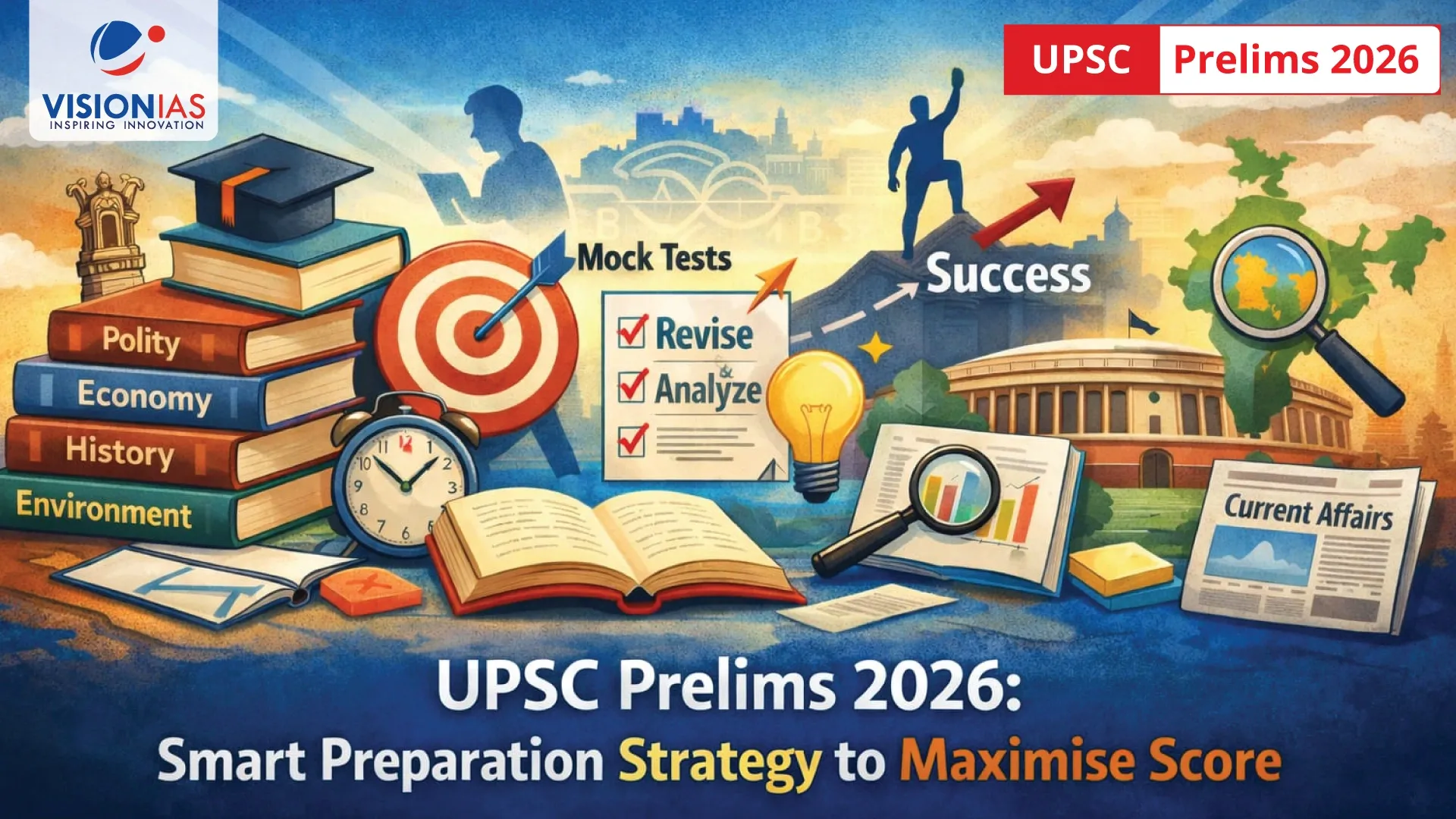
UPSC Prelims 2026: Smart Preparation Strategy to Maximise Score























Every year, after the UPSC Prelims results are declared, a familiar pattern emerges. Thousands of aspirants who have studied sincerely for months — sometimes for years — find themselves on the wrong side of the cutoff. The heartbreak is often accompanied by the same confusion: “I had covered the syllabus. I had studied everything. Where did it go wrong?”
The uncomfortable but necessary truth is this: UPSC Prelims is not an exam of how much you have studied. It is an exam of how effectively you can use what you have studied.
Prelims is not a memory test. It is not a book-completion contest. It is a high-pressure decision-making exam, where success depends on recall, elimination, conceptual clarity, and psychological control in a very short span of time.
As the UPSC Notification 2026 is out, Prelims 2026 cycle enters its decisive phase, aspirants must make a fundamental shift — from a coverage-driven mindset to a performance-driven strategy.
Watch: UPSC Prelims 2026: 4-Month Study Plan to Maximize Score
But before we talk about strategies, plans, and timelines, it is important to confront a more uncomfortable question: Why do so many sincere, hardworking aspirants still struggle in UPSC Prelims?
Why Most Aspirants Struggle in UPSC Preparation
Most aspirants are not lacking in effort in UPSC preparation. They read for long hours, attend classes, watch lectures, and make notes. Yet, four silent cognitive problems keep repeating in almost every preparation journey.
- First, many aspirants read but do not truly understand. Pages move, chapters finish, but the mind never pauses to ask, “Can I explain this in my own words?”
- Second, even when they understand, they do not know how to reduce and retain information. Everything feels important, so nothing becomes revision-friendly.
- Third, they postpone testing. There is always a belief that tests should be attempted only after “full preparation”. That stage rarely arrives.
- And finally, revision does not happen in a systematic way. Months later, the same topic feels unfamiliar again, creating the illusion that nothing has been retained.
Alongside these cognitive issues, aspirants also suffer from behavioural and psychological traps. There is constant comparison with others. There is overconsumption of online content which feels productive but produces very little long-term retention. There is procrastination disguised as planning, perfect timetables that never get executed. And there is perfectionism, the urge to do everything instead of doing what actually matters.
In recent years, these have been joined by newer anxieties: fear of missing out on sources, fear of better options, fear that something crucial is being left out. Slowly, UPSC preparation becomes stress management instead of exam management.
The Science of High-Yield Learning: Why Some Effort Works and Some Doesn’t
Modern learning science and long experience with competitive exams point to one clear conclusion: not all study time is equal. Passive reading creates familiarity, not mastery. Real learning happens when the brain is forced to recall information, apply it, make mistakes, correct them and revisit the same material multiple times
This is why high-yield learning is always cyclical: read → test → analyse → revise → read again. Two important principles from cognitive psychology are especially relevant for Prelims preparation.
- The first is the Kaizen principle — the idea of continuous, small improvements. Instead of setting unrealistic goals like “finish one book in five days”, it is far more powerful to set daily, achievable micro-targets and close them properly. Ten pages revised well, tested, and noted down will take you much further than fifty pages read passively.
- The second is the Zeigarnik effect — the brain remembers unfinished tasks better. When you deliberately leave a small part of a topic for later, your mind stays curious and retention improves when you return to it.
Understanding this science is the first step towards transforming UPSC preparation from random hard work into structured, score-oriented progress.
And once this mental shift is made, the next obvious question becomes: how should one think about different GS subjects and current affairs from a strategic, exam-oriented perspective?
Subject-Wise UPSC Strategy: How to Think About GS and Current Affairs
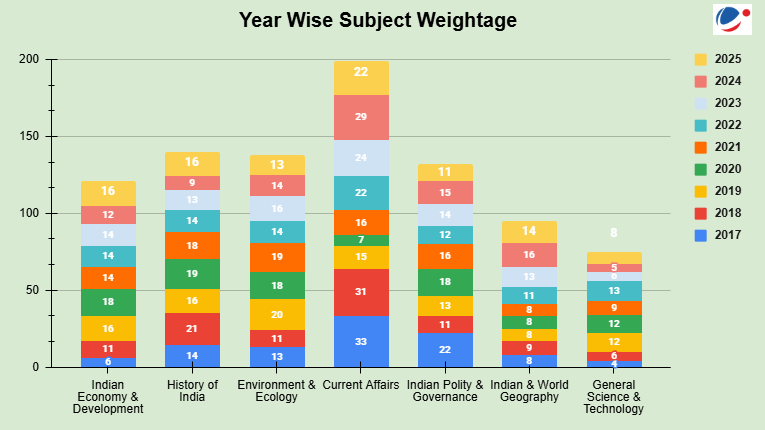
One of the most common strategic mistakes aspirants make is treating UPSC Prelims GS as an equal-weight exam. It is not. Year after year, certain subjects — and more importantly, certain themes within those subjects — dominate the paper.
Polity, Economy, Environment, History, Geography, and Current Affairs together form the core of the exam, but even within these, UPSC repeatedly tests specific micro-areas rather than the entire syllabus in equal proportion.
This is why subject-wise preparation for Prelims must not be about “finishing books”. It must be about stabilising high-frequency zones and revising them in a way that makes recall and elimination automatic.
- Take Polity, for instance. The questions consistently revolve around constitutional provisions, rights, Parliament, judiciary, governance structures, and current-affairs-linked amendments and institutions. You do not need to remember every article of the Constitution. What you need is deep, exam-ready clarity in the repeatedly tested constitutional zones. This is precisely why short, focused GS quick-revision modules help in theme-based revision which is valuable at this stage and helps compress a vast subject into recall-oriented, test-facing structures rather than chapter-wise memory.
- Economy follows a similar pattern. Despite its apparent vastness, Prelims economy largely revolves around a few big pillars: monetary policy, fiscal policy, the Budget, agriculture, and the external sector. Here, current affairs does not replace static understanding; it decides what part of static needs to be revised more sharply. This is also why the period after the Economic Survey and Union Budget becomes strategically critical. A focused VisionIAS Economy Sprint program built around Economic Survey and Budget analysis helps aspirants not only understand current policy direction but also revise the underlying static concepts in exactly the areas UPSC is most likely to test.
- Environment and Science & Technology, in recent years, have become both high-scoring and high-risk areas. Environment is driven by core ecology concepts, biodiversity, conventions, climate change, and protected areas, while Science & Tech is largely current-affairs driven but always resting on basic conceptual foundations. These subjects do not reward endless reading; they reward smart, selective, high-frequency revision. This is where a VisionIAS Prelims Speed-Up module for Environment and S&T focuses on high-probability themes, integrated current affairs, and repeated MCQ exposure makes preparation more efficient and more exam-aligned.
- History is a classic example of a subject that defeats aspirants who approach it emotionally rather than strategically. It is vast, but UPSC is selective. Certain civilisations, certain phases, and certain cultural areas are over-represented year after year. Trying to treat history like a storybook is a strategic mistake. It must be treated like a pattern-recognition exercise, supported by selective deepening of high-yield areas. VisionIAS focused Prelims Speed-Up modules for History help in exactly this: cutting through the bulk and stabilising what actually matters for the exam.
- Geography, on the other hand, is increasingly becoming a subject where concepts, maps, and current relevance intersect. Many questions today cannot be solved without spatial understanding and location-based clarity. This is why VisionIAS Smart Mapping program provides application-oriented spatial geography which is central to serious Prelims preparation.
Running through all of this is the thread of Current Affairs. Current Affairs should never be seen as a separate subject. It should be seen as a lens through which you prioritise and sharpen your static revision. A well-structured annual compilation like PT365 serves exactly this purpose not as something to be memorised mechanically, but as a strategic filter that tells you which parts of your static syllabus deserve the most attention this year.
When subject-wise preparation is organised in this way through focused revision modules, smart mapping, Economy sprint, Prelims SpeedUpt programs, and exam-oriented current affairs integration the syllabus stops feeling infinite and starts becoming strategically manageable.
And that is precisely the shift Prelims demands: not more study, but better-targeted study.
Smart Study Plan: Thinking in Phases, Not in Panic
UPSC Preparation must now move in clear phases, not in a vague “I will try my best” mode.
- The first phase should focus on rebuilding your core foundation — revising static along with PYQs, compressing notes, and making your material revision-ready.
- The second phase should shift towards test-based revision — not to chase marks, but to identify weak areas, mistake patterns, and elimination errors.
- The third phase should intensify testing and systematically repair weak zones.
- The final phase should be about polishing and calming — not learning new things, but stabilising what you already know.
If structured properly, this naturally ensures multiple revisions without panic.
Practice Strategy: Using Tests as Training, Not as Judgment
Many aspirants fear tests because low scores hurt the ego. But tests are not meant to judge you. They are meant to show you where you stand.
A test reveals what you cannot recall under pressure, where your thinking goes wrong, and which traps you fall into repeatedly. Real improvement does not come from chasing scores. It comes from test analysis and error correction. Those who clear Prelims are not the ones who never make mistakes in mocks, but the ones who stop repeating the same mistakes.
Practice, therefore, must be regular and structured, not occasional. Sectional tests stabilise subjects; full-length tests build exam temperament. At this stage, an All India Prelims Test Series, especially when combined with a structured practice and analysis platform like Sandhan 2026, helps bring discipline, highlights weak areas early, and replaces guesswork with evidence-based feedback.
The purpose of practice is simple: to reduce uncertainty on the actual exam day by turning testing, analysis, and revision into one continuous loop.
Conclusion
UPSC Prelims is not cleared by the most knowledgeable person in the room. It is cleared by the one who remains calm under pressure, recognises patterns in questions, avoids avoidable mistakes, trusts their preparation, and has revised their core material enough times for it to become instinctive.
Success in Prelims is built far more on stability and repetition than on brilliance or last-minute heroics. That is why the real work must begin now, not tomorrow. Start small, but start structured. Over time, momentum creates progress, progress builds confidence, and it is this confidence, quietly earned over months of disciplined preparation, that finally clears Prelims.