Prelims
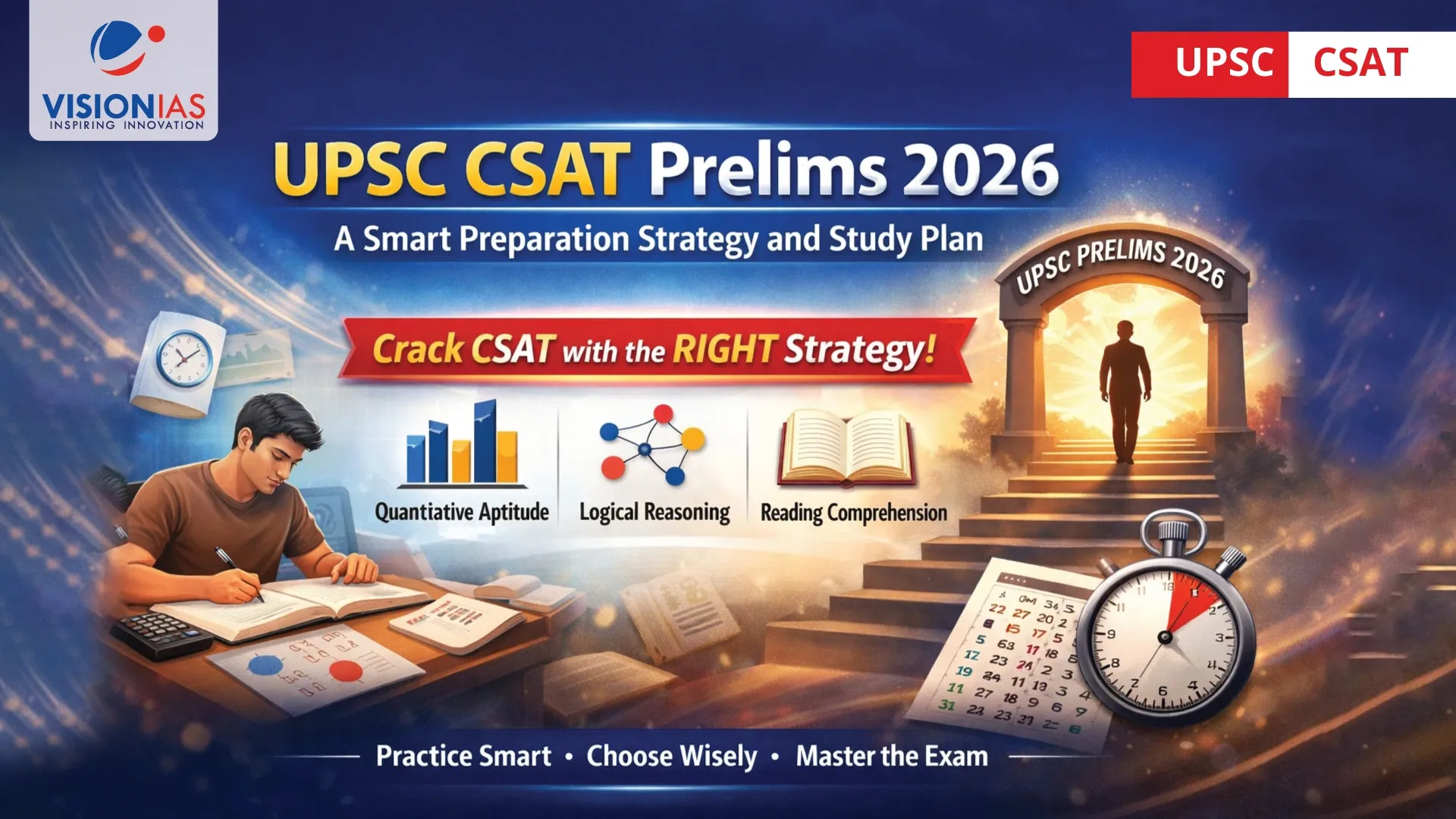
UPSC CSAT Prelims 2026: A Smart Preparation Strategy and Study Plan

























Every year, after the UPSC Prelims results are declared, one reality becomes impossible to ignore: many strong GS candidates do not move ahead—not because they lack knowledge, but because CSAT quietly became the deciding factor.
The tragedy is that UPSC CSAT failures rarely come from “not studying enough.” They come from wrong assumptions treating CSAT as a paper you can manage at the end, attempting it with a casual mindset, or relying on vague “aptitude” confidence instead of structured training.
Watch: Learnings From 2025 & How to Prepare CSAT for 2026 Prelims
With the UPSC CSE 2026 notification now released, the Prelims 2026 cycle has officially begun. This is precisely the stage at which aspirants must confront a risk that often goes unnoticed until it is too late. That risk is CSAT.
Why UPSC CSAT Becomes the Silent Reason Behind Prelims Failure
Most aspirants prepare GS with discipline, revision cycles, and test analysis. CSAT, however, is often left to “later.” The logic sounds harmless: “It’s only qualifying.” But in a paper where you still need to cross a clear qualifying benchmark, that mindset creates two predictable risks:
- Skill gaps stay hidden for months: If your comprehension speed is slow, if your mental maths is shaky, or if your reasoning accuracy drops under pressure—these weaknesses do not announce themselves in theory. They show up only inside timed practice.
- The exam day pressure multiplies mistakes: CSAT is not just about solving questions. It is about solving the right questions fast enough, while staying calm, choosing wisely, and not bleeding time on traps.
That is why aspirants with excellent GS performance can still lose the Prelims journey due to one weak area, one wrong approach, or a poorly managed attempt strategy.
UPSC CSAT 2026 Mindset: Treat It as a Subject, Not a “Backup Paper”
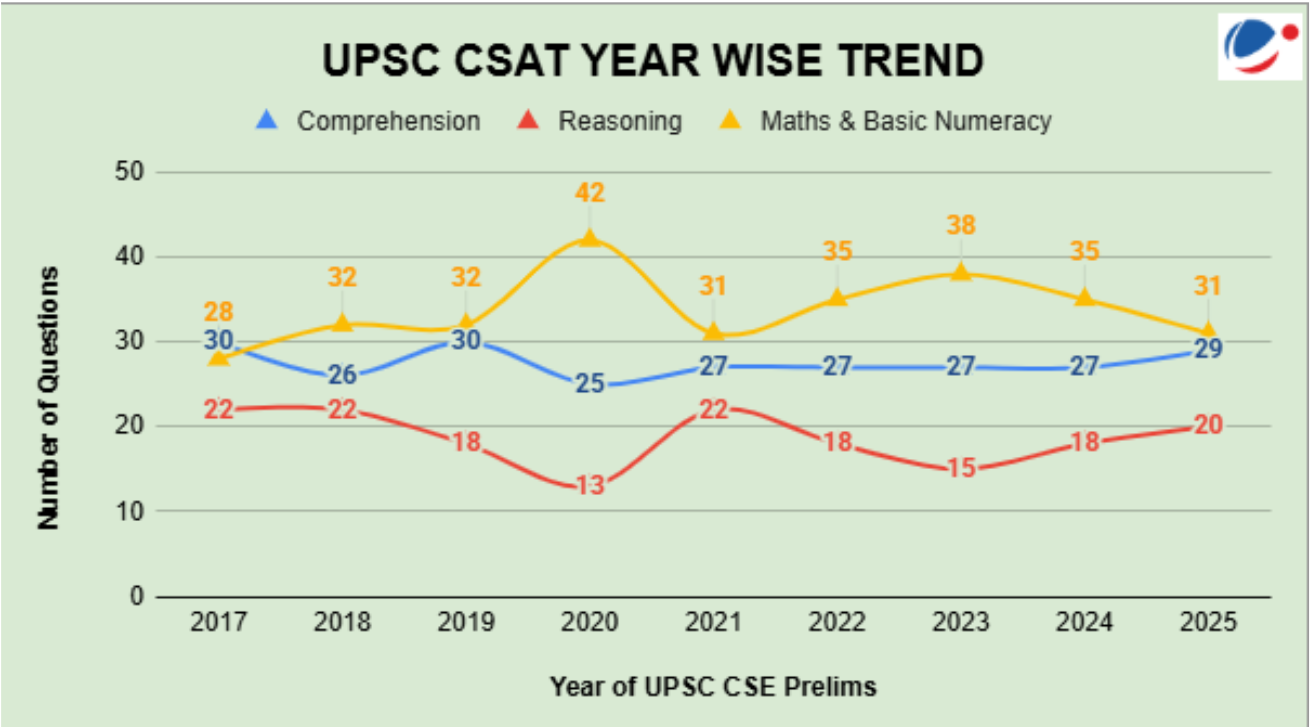
CSAT has three core components:
- Quantitative Aptitude / Numeracy
- Logical Reasoning
- Reading Comprehension
The mistake is assuming these are “basic” skills. In reality, these are trainable skills—and trainable skills require continuity. Aspirants usually get stuck in one of two extremes:
- Either they start too late and then panic-practice randomly, or
- They over-practice without a strategy, solving hundreds of questions but never improving speed, selection, and accuracy.
The right approach is the middle path: consistent, targeted practice, not daily heavy hours, but structured weekly (and later daily) training—so that CSAT becomes stable, predictable, and manageable.
The Real UPSC Prelims CSAT Skill: Question Selection
A high CSAT score is rarely built by solving the maximum number of questions. It is built by solving the most doable questions with high accuracy.
This is where most aspirants lose marks:
- They treat every question as “must attempt.”
- They spend too long trying to crack tough questions because they already invested time.
- They ignore the simplest truth: CSAT rewards the art of skipping.
In CSAT, skipping is not a weakness. Skipping is a strategy. A good attempt is not just about courage, it is about control i.e Knowing what to attempt first, what to leave immediately, how to avoid time traps, how to lock accuracy before expanding attempts.
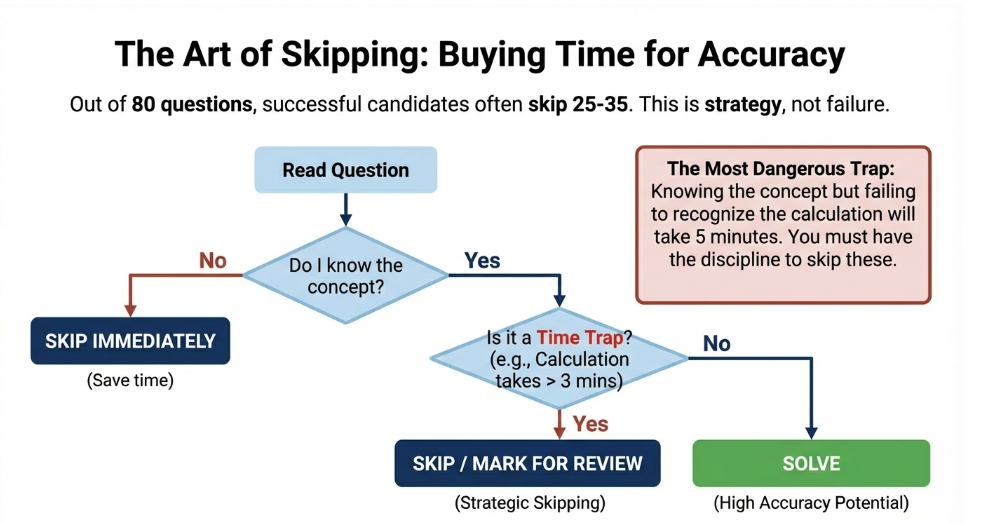
If you master selection, speed automatically improves, because you stop wasting minutes on high-effort low-return questions.
What to Prioritise in UPSC CSAT 2026: Build Strength Where the Paper Repeats Patterns
CSAT is not random. It changes in style, but it remains consistent in recurring skill zones. Instead of trying to “finish everything,” build stability in the areas that repeatedly dominate scoring opportunities.
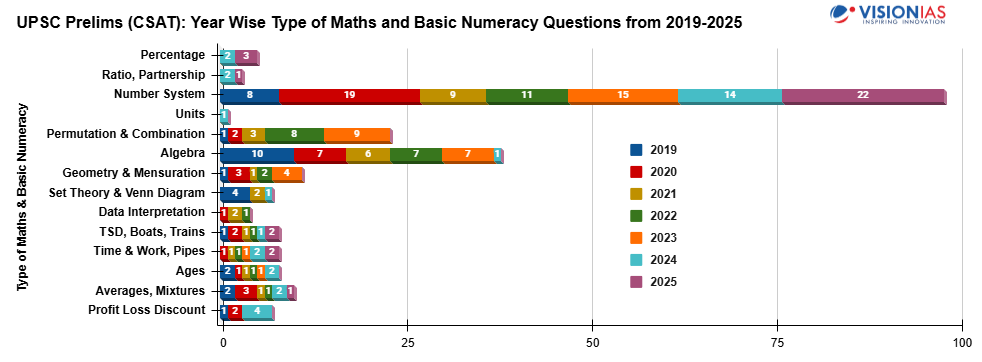
1) Numeracy: Make One Area Unshakable Before Expanding
Many aspirants try to do “all maths topics” together and end up mastering none. The better route is targeted consolidation.
Start with the most foundational, repeatedly tested core:
- Number System and its extensions (remainders, divisibility, units digit logic, cyclicity)
- Percentages, ratio-proportion, averages, mixtures
- Simple algebraic reasoning (linear equations based thinking)
- Data-based logic that tests condition checking, not long calculation
A key recent shift has been the growing importance of data sufficiency-type logic, where the skill is not to calculate fully, but to decide whether information is sufficient.
The goal here is not to become a mathematician. The goal is to become fast and accurate in limited patterns.
2) Reading Comprehension (RC): The Most Underestimated Score-Booster
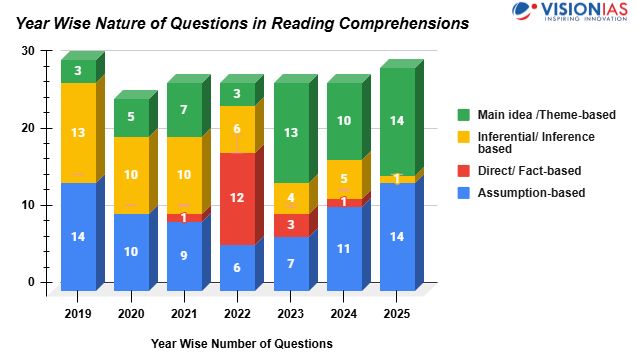
Aspirants often assume RC is “English-based.” That is a misconception. RC in CSAT is fundamentally about:
- Reading quickly without losing meaning
- Identifying what the question is really asking
- Avoiding option traps caused by extreme words or misinterpretation
In other words, RC tests decision-making through language. The biggest RC improvement comes when you stop reading passively and start reading with a “question lens”:
- What is the tone?
- What is the central claim?
- What is explicitly stated vs implied?
- Which option is closest to the author’s intent?
RC becomes a strength when practiced consistently, even for 15–20 minutes daily, because it is a habit skill—not a memory skill.
3) Logical Reasoning: Build Accuracy First, Then Speed
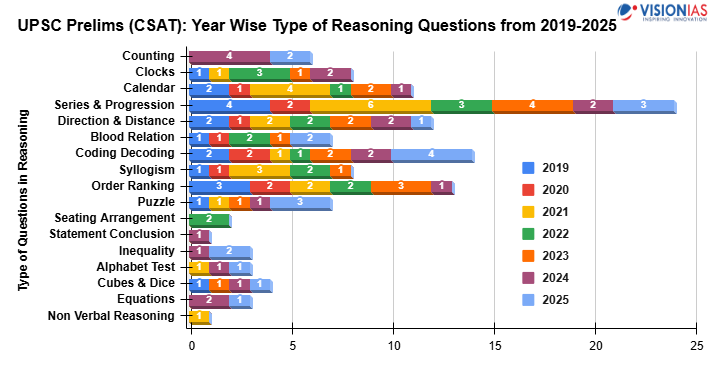
Reasoning is where aspirants waste time because they attempt it without structure. The improvement is simple:
- Identify the recurring formats you can solve quickly (basic arrangements, condition-based puzzles, statements/conclusions)
- Avoid time-heavy puzzles unless they are clearly doable
- Build accuracy through timed sets, not just random practice
Reasoning success comes not from quantity of questions solved, but from pattern familiarity under time pressure.
The CSAT Study Plan for UPSC 2026: A Practical, Non-Panic Structure
The biggest advantage in CSAT is starting early—not with heavy hours, but with small consistent blocks. And one of the most important is to solve PYQs to get familiar with the nature of questions.
Phase 1: Foundation + Stability (Start Now)
Goal: Remove fear and build base comfort.
A simple weekly structure works well:
- 2 short sessions for Numeracy
- 2 short sessions for RC
- 1 short session for Reasoning
This keeps continuity without disturbing GS preparation.
Register: CSAT Crash Course 2026
Phase 2: Mixed Practice + Timed Sets (Once Basics Feel Comfortable)
Goal: Train the exam brain.
Now shift from topic practice to timed mixed sets, because CSAT is not solved topic-wise in the exam. It is solved as a mixed decision paper.
At this stage:
- Do not chase long practice hours
- Chase timed improvement: speed, questions selection and accuracy
Phase 3: Full-Length CSAT Simulation (Closer to Prelims)
Goal: Build temperament and attempt strategy.
This is the stage where many aspirants finally realize:
- Their speed drops after 60 minutes
- Their accuracy collapses after 75 minutes
- They lose time because they attempt hard questions too early
Full-length mocks are not for showing performance. They are for revealing your test-taking behaviour.
Register: All India CSAT Test Series 2026
UPSC Prelims CSAT Practice Strategy: The “Test-Taking Ability” You Must Build
Once you begin multiple revisions and enter the mock phase, your real upgrade is not “content.” It is your test-taking ability—how you behave inside the paper.
A productive CSAT practice cycle looks like this:
- Attempt under time
- Identify whether time is your hurdle
- Check whether you spend too long reading questions
- See whether you miss elimination words/keywords
- Note blunders and repeated mistakes in one utility notebook
This single habit of tracking repeated mistakes changes everything, because CSAT failure usually comes from repeating the same errors, not from lacking intelligence.
How to Set a Safe Attempt Strategy Without Guesswork
CSAT becomes dangerous when you walk into the exam without a clear plan. A stable attempt plan reduces uncertainty. A sensible approach is:
- Start with your highest-confidence zone to lock accuracy
- Move to the next-highest confidence zone
- Keep tougher questions for last
- If stuck for too long, skip immediately
The objective is not to attempt “everything.” The objective is to clear with safety, calm, and control.
Conclusion: Don’t Let CSAT Decide Your Prelims Story
CSAT should never be the surprise element in your UPSC Prelims 2026 journey. It is a qualifying paper, yes—but it demands subject-like seriousness.
If you start now with small, consistent practice, CSAT becomes predictable. It becomes a controllable paper, not a stress factor. And once CSAT is stable, your GS performance can actually matter the way it is meant to.
Begin with discipline, not panic. Train for selection, not impulse. And walk into Prelims 2026 with the calm confidence that comes only from preparation you can truly trust.