Sociology Optional
UPSC Optional Sociology 2025 Paper II – Reflections and Thematic Analysis
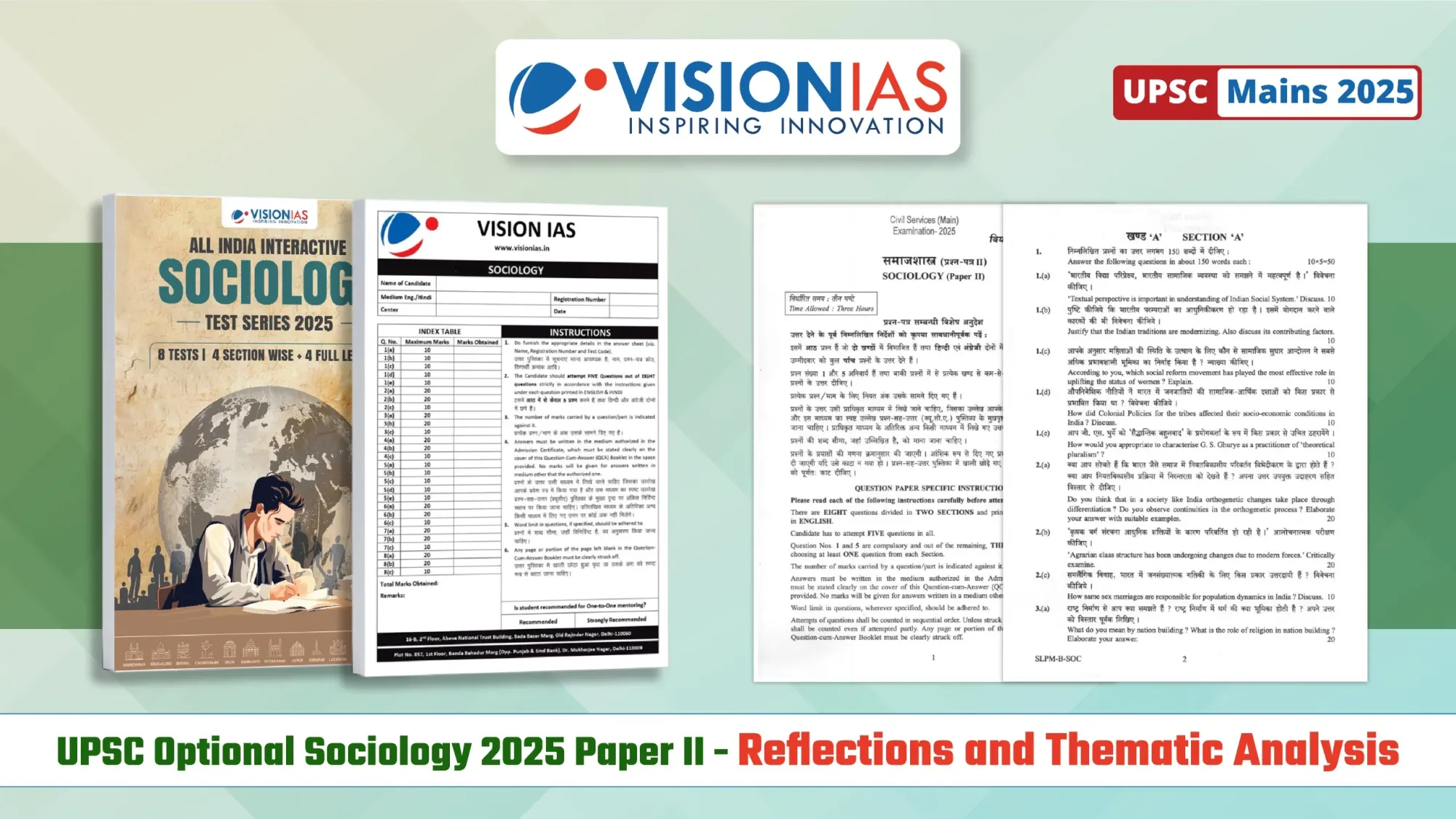


















UPSC Mains 2025 Sociology Paper-II tested how well aspirants could apply sociological frameworks to Indian society—across caste and class, gender and family, rural–urban change, politics, religion, social movements, and development.
What stood out this year was the blend of evergreen areas (caste dynamics, village/agrarian change, gender relations) with contemporary concerns (digital influence, social policy evaluation, grassroots mobilisation). This demanded analytical clarity and the ability to connect theory with current realities.
Download UPSC Mains 2025 Sociology Optional Question Papers PDF (Paper 1 & 2)
At VisionIAS, our All India Sociology Test Series is designed for exactly this balance—training aspirants to move from concept to application with model answers, evaluation, and progressive test coverage.
Before we dive into the themes, here’s how the All India Sociology Test Series mapped onto this year’s paper.
Reflections in Sociology Paper-II from VisionIAS Mains Test Series
This year, the Sociology Paper-II showcased 17 out of 28 questions reflected in the VisionIAS All India Sociology Test Series, either directly or thematically. The overlap illustrates the effectiveness of our systematic test design, which ensures that aspirants repeatedly engage with the core concerns of Indian society in ways that mirror the actual exam.
With the reflection established, the following thematic breakdown organises the paper’s demand area-wise and translates it into preparation cues for 2026.
Thematic Analysis of Sociology Paper-II (2025) and strategy for 2026
Following thematic analysis provides a structured breakdown of the paper, highlighting the recurring focus areas, evolving trends, and predictable themes that can guide preparation for upcoming attempts. By studying the distribution of questions and thematic trends, aspirants can sharpen their strategy for 2026 and beyond.
A. Theoretical & Conceptual Foundations
- Textual perspective in understanding Indian social system
- Orthogenetic changes through differentiation & continuities
- G.S. Ghurye as practitioner of theoretical pluralism
- Industrial class structure as function of Indian social structure
- Nation-building and role of religion
Trend: Every year, approx.5 questions test direct theory + Indian application. Takeaway: Prepare major Indian sociologists (Ghurye, Srinivas, Karve, D.P. Mukerji, Yogendra Singh) + concepts (Sanskritization, modernization, secularization, orthogenesis).
B. Colonial Impact & Historical Change
- Colonial policies for tribes & socio-economic conditions
- British economic reforms disrupting old Indian system
Trend: UPSC loves colonial- post-colonial continuity. Takeaway: Always prep colonial impact on caste, agrarian structure, tribes, urbanization.
C. Social Change, Modernization & Development
- Indian traditions modernizing + contributing factors
- Agrarian class structure & modern forces
- Urbanization trend: is industrialization the only precondition?
- Sustainable development in India – issues & measures
Trend: Post-2018, more questions link structural changes with modern policies + globalization.
D. Caste, Tribe & Social Stratification
- Measures to prevent caste conflicts
- Dalit movements and identity formation
- Constitutional provisions and socio-political change for SC/ST
Trend: Repeated every year- caste mobility, conflicts, identity, politics. Takeaway: Must connect to contemporary issues (caste census, reservation debates, SC/ST atrocities).
E. Class & Middle Class
- New Indian middle class vs old middle class
Trend: Middle class is evergreen.
Earlier PYQs: consumerism (2016), globalization & class (2020), new middle class emergence (2021). Takeaway: Use data (NCAER, Pew, CSDS), highlight consumer culture, precariat, aspirational politics.
F. Gender & Family
- Which reform movement uplifted women most?
- Same-sex marriages & population dynamics
- Kinship – G.P. Murdock’s contribution
Trend: Gender/family questions appear every year: patriarchy, women movements, kinship systems. Takeaway: Link to recent legal issues (same-sex marriage SC judgment 2023, UCC debates, NEP’s gender inclusivity).
G. Village, Agrarian & Rural Economy
- Village studies & pioneers
- Decline of village industries
- Transfer of land from cultivators to non-cultivators – social change
Trend: Classic Paper II – agrarian structure, village studies, rural change. Takeaway: Prepare Srinivas, Dube, Katar Singh, and current themes (agrarian crisis, farm bills, rural-urban migration).
H. Labour, Migration & Informal Sector
- Problems of labour migrants in informal sectors
- Forced displacement of labourers deprivation & inequalities
Trend: Labour & migration has gained prominence post-COVID (2020). Takeaway: Use PLFS, ILO reports, migrant workers crisis during lockdown.
I. Law, Policy & Social Problems
- Law abolishing child labour – has it succeeded?
- Poverty alleviation schemes after SDG-2015
- Educational development as panacea – NEP-2020 reference
Trend: Law/policy questions now must connect to schemes + evaluation (e.g., POSHAN Abhiyan, NEP, MGNREGA).
J. Ageing & Social Security
- Private & public support systems for the aged + challenges for caregivers
Trend: Old age/ageing appears every 3–4 years (2015, 2019, 2025). Takeaway: Connect to NFHS-5 data on elderly, WHO “Decade of Healthy Ageing,” pensions, family disintegration.
K. Political Sociology & Mobilization
- Social bases of political mobilization in independent India – changes in last 60–70 years
Trend: Politics + society is always tested (2018: secularization, 2020: democracy, 2022: movements). Takeaway: Use Yogendra Yadav, Rajni Kothari, Suhas Palshikar’s frameworks.
Broad Theme Distribution (2025 – 28 Questions)
Big Takeaways for 2026
Evergreen Core Themes
- Caste, Class, Tribe: Continuity of questions on mobility, conflicts, and identity formation.
- Gender & Family: Reform movements, patriarchy, kinship, marriage laws, and new issues like same-sex marriage.
- Agrarian & Village Studies: Land transfer, agrarian class, rural industries, and village studies (Srinivas, Dube, Shah).
- Labour & Migration: Informal economy, forced displacement, migrant crises.
- Political Mobilization: Electoral changes, regionalism, Dalit/Bahujan politics.
- Social Problems & Policy: Poverty, child labour, ageing, education, sustainable development.
Emerging & Current Themes
- Digital Labour & AI: Impact on informal sector, precariat class.
- Climate Change & Displacement: Tribals, coastal communities, “climate refugees.”
- Caste Census & Demographic Debates: Identity politics in 2025–26.
- Urbanization Beyond Industry: Migration, services, IT corridors.
- Gender & Policy: Women’s Reservation Bill (passed 2023, first election impact 2029).
Anniversaries / Milestones Relevant for 2026
10 Years (2016 – 2026)
- GST Act (2016) impact on informal sector, federalism.
- Demonetisation (2016) impact on cash economy, informal labour.
- Smart Cities Mission (2015–16) urban sociology perspective.
- Maternity Benefit (Amendment) Act, 2016 Women & work, gender equality, work–family balance, labour rights
- Rights of Persons with Disabilities Act, 2016 (RPwD Act) Social inclusion, affirmative action, rights-based approach.
- Child Labour (Prohibition & Regulation) Amendment Act 2016.
20 Years (2006 – 2026)
- Domestic Violence Act (2005–06) women’s rights, family sociology.
- Forest Rights Act (2006) tribals, land rights, displacement.
- RTI Act (2005–06) transparency, governance, civil society role.
- National Rural Health Mission (2005) public health and development.
25 Years (2001 – 2026)
- Census 2001 (debates around caste, religion, migration) now linked to caste survey politics.
- IT Act (2000, expanded in 2001) -digital society, cyber security.
50 Years (1976 – 2026)
- 42nd Constitutional Amendment (1976)- socialism, secularism, fundamental duties.
- Bonded Labour System Abolition Act (1976) -labour exploitation.
- Urban Land Ceiling Act (1976) -land reforms & urban sociology.
Preparation Strategy with Anniversaries
For every anniversary-linked law/policy, prepare:
- Background (why it was enacted).
- Impact (success/failures with data).
- Contemporary relevance (link to today’s issues).
- Scholarly views (e.g., FRA : Virginius Xaxa; RTI : Aruna Roy).
Expected Question Frames for 2026
- “Critically examine the role of GST in reshaping India’s informal economy over the last decade.”
- “Discuss how 20 years of Forest Rights Act has shaped tribal identity and development.”
- “Evaluate the Domestic Violence Act in 20 years: has it transformed family relations in India?”
- “How has the 42nd Amendment (1976) changed the course of Indian constitutionalism?”
- “After 25 years of IT Act, how has digital society reshaped class and identity in India?”
Sources for Contemporary Topics in Sociology (Paper II)
Conclusion: Strategy for 2026—From Concepts to Context
The 2025 paper rewarded answers that joined classical concepts with India’s lived realities. Use the thematic map above to prioritise:
- Foundations: Indian sociologists, methods, and core theories to anchor arguments.
- Application: Policy milestones, legal changes, data/examples for contemporary linkage.
Align this with structured practice (sectional + full-length tests), targeted evaluation, and iterative refinement. That rhythm builds analytical precision and the exam-ready confidence Paper-II demands.